

Aug 6, 2020August is key time for protecting clusters from grape berry moth
As the 2020 grape crop begins to ripen, thoughts turn to harvest preparations and ensuring your clusters remain in good shape through August and into September.
So far this season we are seeing decent levels of control of early season berry moth infestations. This article focuses on the next month, as clusters ripen and berry moth populations continue to build. Controlling this generation is very important to reduce yield loss and disease development associated with larvae infesting berries.
Information in this article is focused on high pressure vineyards—those that have a history of berry moth infestation, were heavily infested last year or saw high infestation this year before veraison. Scouting vineyards now for berry moth infestation can tell you where to focus efforts for the rest of the season. Vineyards next to woods, tree lines or even a single tree can get much higher berry moth pressure, so start with these sites. We are already seeing the typical higher pressure at vineyard edges compared to vineyard interiors. A check in these two locations can help you decide if you can get away with insecticide only at the vineyard borders (typically 10-15 rows).
Timing
Based on the berry moth model at Michigan State University Enviroweather as of Aug. 3, 2020, the third generation berry moth egg-laying is starting in far southwest Michigan. As growing degree days (GDD) accumulate in other regions, this will start in more northern regions later in the month (see table).
| County | Wild grape bloom date | Predicted 1,620 GDD start of third generation egglaying | Predicted 1,720 GDD start of third generation egg hatch |
|---|---|---|---|
| Berrien (SWMREC) | June 2 | Sunday, Aug. 2 | Saturday, Aug. 8 |
| Van Buren (Lawton) | June 4 | Friday, Aug. 7 | After Aug. 9 |
| Allegan (Fennville) | June 5 | After Aug. 9 | After Aug. 9 |
| Ottawa (West Olive) | June 11 | After Aug. 9 | After Aug. 9 |
| Grand Traverse (Old Mission) | June 12 | After Aug. 9 | After Aug. 9 |
Note that the model only predicts the start of egg-laying (for timing insecticides that are mostly egg-active) and the start of egg hatch by berry moth (for insecticides targeting the larvae). The third generation of berry moth lasts longer than one insecticide application can cover. Once the next application is applied, be prepared to return and protect against the second half of the generation starting about two weeks later.
Insecticide selection
For insecticides with activity on berry moth eggs such as insect growth regulators and diamides (Intrepid, Intrepid Edge, Altacor and Verdepryn), make applications starting at the 1,620 timing. Intrepid (12 ounces per acre) or Intrepid Edge (12 ounces per acre) applied at this timing provide long-lasting control of berry moth eggs and larvae, giving two to three weeks of protection. Intrepid is very selective for berry moth control while Altacor (4.5 ounces per acre) and Intrepid Edge have a wider spectrum, also controlling Japanese beetles and some other pests.
These products are relatively resistant to high heat and Intrepid is quite rainfast, making them a good choice for the predicted weather conditions. They need excellent cluster coverage to work best, so use a spreader/sticker, appropriate sprayer setup and high enough water volume to get under leaves and cover the clusters. This is important for all berry moth sprays, but especially for those targeting the eggs.
For insecticides that target larvae, waiting until the predicted egg hatch at around 1,720 GDD (later in August) is advised so the insecticides are able to control the young larvae when they hatch and try to get into the berries. For this timing, the broad-spectrum insecticide Imidan (2 pounds per acre) is effective against berry moth. Apply Imidan in water that is pH 5-5.5 for maximum activity– note the 14-day re-entry! Altacor (4.5 ounces per acre), Delegate (5 ounces per acre) and Verdepryn (11 ounces per acre) can also be used at this timing since they have activity against young larvae.
There are also multiple biologically based insecticides that can reduce berry moth infestation when applied on a tighter seven-to-10 day interval. These include Grandevo (3 pounds per acre), Venerate (6 pounds per acre), Spear-Lep (2 pounds per acre) and B.t. containing products, such as DiPel and Javelin (1.5 pounds per acre), that will each allow for biological control agents to maintain activity in the vineyards.
There are many broad-spectrum insecticides registered on grapes for controlling this pest. Pyrethroids such as Danitol and Baythroid have high activity but they can break down faster in the presence of high heat and UV. Within the pyrethroids, bifenthrin is unusual in being relatively unaffected by high heat conditions, so products such as Brigade, Bifenture and Brigadier are good choices when temperatures get into the 90s. Sevin is another broad-spectrum insecticide option but it does not provide long-lasting activity against berry moth.
In addition to the pre-mix Intrepid Edge mentioned above, Tourismo and Leverage 360 are products that contain two insecticide active ingredients with good activity against berry moth.
Vineyards with high pressure from berry moth are likely to require a follow-up spray against this pest 10-14 days later, depending on the insecticide used, In sites where this pest was an issue in 2019, please continue scouting and be prepared for further protection as harvest approaches.
These are general recommendations and there is no substitute for looking in your own vineyards to see what this pest is doing on your farm this season. You can learn a lot by getting out of the cab and checking clusters around the farm and seeing how well your insect management program is performing.
A fourth generation?
We have had a relatively warm summer so far, and timing of berry moth has advanced so that egg-laying by this third generation is starting in early August. This makes it likely that some of the berry moth larvae surviving this generation will be primed to try for another generation in September/October. We will continue to monitor this and let growers know what we are seeing. This also highlights the need for excellent control of the third generation to reduce the number of larvae surviving to the fourth generation.
– Rufus Isaacs and Jacquelyn Perkins, Michigan State University Department of Entomology, and Michael Reinke, Michigan State University Extension
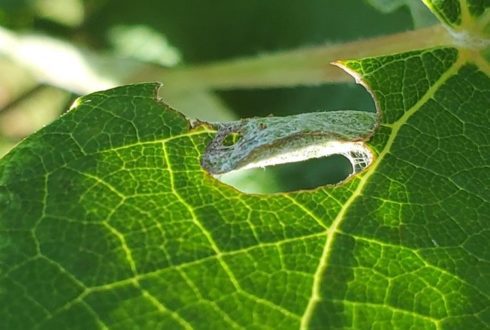
A pupa of grape berry moth, wrapped inside a flap of grape leaf, cut by the berry moth larva. Photo: Jackie Perkins/MSU Entomology.






Current Issue

On-farm AI: Water, farm, labor research guide decisions
Data collection tool expands farm management
Carmel Valley winegrapes: Parsonage Village Vineyard
IFTA Yakima Valley tour provides orchard insights
IFTA recognizes tree fruit honorees
Pennsylvania recognizes fruit industry professionals
Fresh Views 40 Under 40
see all current issue »