

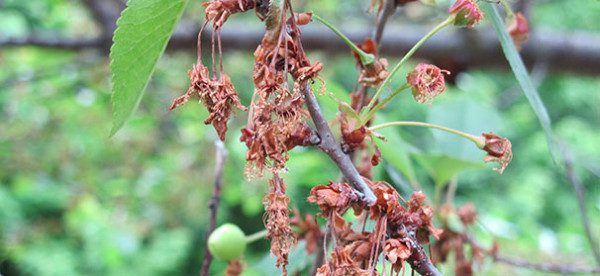
Mar 27, 2014European brown rot could hit cherries again
There was a major outbreak of European brown rot in Michigan’s tart cherry crop in spring 2013. Hopefully, there won’t be an outbreak this year, but much depends on the weather, said George Sundin, a Michigan State University professor.
The outbreak hit hardest in northwest Michigan, and the surprising thing was that infection levels were quite high in the Montmorency variety – which makes up more than 90 percent of the Michigan crop, Sundin said.
Traditionally, European brown rot has been a significant problem in the Balaton variety. You’d see occasional, sporadic infections in Montmorency, but nothing like what happened in 2013. Some areas were heavily infected and certain orchards looked “completely terrible,” Sundin said. He wasn’t sure how much fruit was lost to last year’s outbreak, but it had a “tremendous effect” on yield.
European brown rot, which seems to be active for about a month, infects and kills flowers and shoots. If 80 percent or more of a tree’s flower clusters are infected, it won’t yield any fruit, he said.
Sundin couldn’t say for sure what caused last year’s unusually intense outbreak, but he suspects spring weather had a lot to do with it. Temperatures were unusually warm last April, for about a week before tart cherry bloom. Sundin thinks that early warmth might have activated the pathogen that causes European brown rot, which can infect flowers before they open. By the time the flowers started blooming, temperatures were back to normal (in the 30s and 40s, optimal for European brown rot). What followed was a wetting event, when relative humidity was greater than 90 percent for two consecutive days. By that time, the pathogen was already activated and ready to sporulate.
The most intense European brown rot infections occurred in areas that stayed wet for long periods – next to Lake Michigan, for example, in low pockets in orchards, or where the cherry trees were surrounded by windbreak trees (poor airflow), Sundin said.
The pathogen likely overwintered in many of the infected trees. If weather conditions in spring 2014 are similar to spring 2013, it could lead to another big outbreak, he said.
There are two main options for fighting European brown rot right now: pruning and spraying fungicide. Pruning can work on lightly infected trees, but isn’t feasible on heavily infected trees. Spraying will most likely tamp down infection, but has to be done at the right time, in the white bud stage before the first rain, Sundin said.
Sundin and other researchers are still working to identify fungicides that are effective against European brown rot, since growers have never had to spray Montmorency trees for that particular disease before. Right now, the only product they’re certain about is Indar, a sterol inhibitor from Dow AgroSciences.
Sundin recommends making two applications of fungicide during bloom this year, and two more in 2015 to get the infection down to pre-2013 levels.
Sundin is working with Nikki Rothwell, director of the Northwest Michigan Horticulture Research Center, to develop a weather-based forecasting system for European brown rot. If things return to normal, fungicides shouldn’t be necessary in most years – but they want growers to be prepared, he said.
Latest News
MSU funds climate projects
Custom Agronomics acquires BioTek Ag





Current Issue

On-farm AI: Water, farm, labor research guide decisions
Data collection tool expands farm management
Carmel Valley winegrapes: Parsonage Village Vineyard
IFTA Yakima Valley tour provides orchard insights
IFTA recognizes tree fruit honorees
Pennsylvania recognizes fruit industry professionals
Fresh Views 40 Under 40
see all current issue »