

Farm labor summer update: H-2A continues record climb
Total H-2A job certifications are up 20% in the second quarter of 2026 compared to the same period in 2025. The program remains on pace for record usage.





Key takeaways
- H-2A job certifications reached 254,688 during the first half of fiscal year 2026.
- Second-quarter certifications increased 20.5% compared with the same quarter in fiscal year 2025.
- Forty-three states expanded H-2A usage during the first half of fiscal year 2026.
- Washington posted the largest increase among leading H-2A states, while Florida remained the largest overall user.
- Full-year H-2A certifications could approach 435,000 if current trends continue.
- Persistent domestic labor shortages continue to drive grower participation in the H-2A program.
As farmers across the country struggle with a domestic labor shortage, use of the H-2A temporary agricultural worker program continues to grow.
With over 250,000-plus positions certified through the first half of fiscal year 2026 (October 2025–March 2026), the program is already tracking well ahead of every prior first half on record and on pace to surpass 2025’s full-year total.
Huge Q2 for H-2A certifications delivers record first half
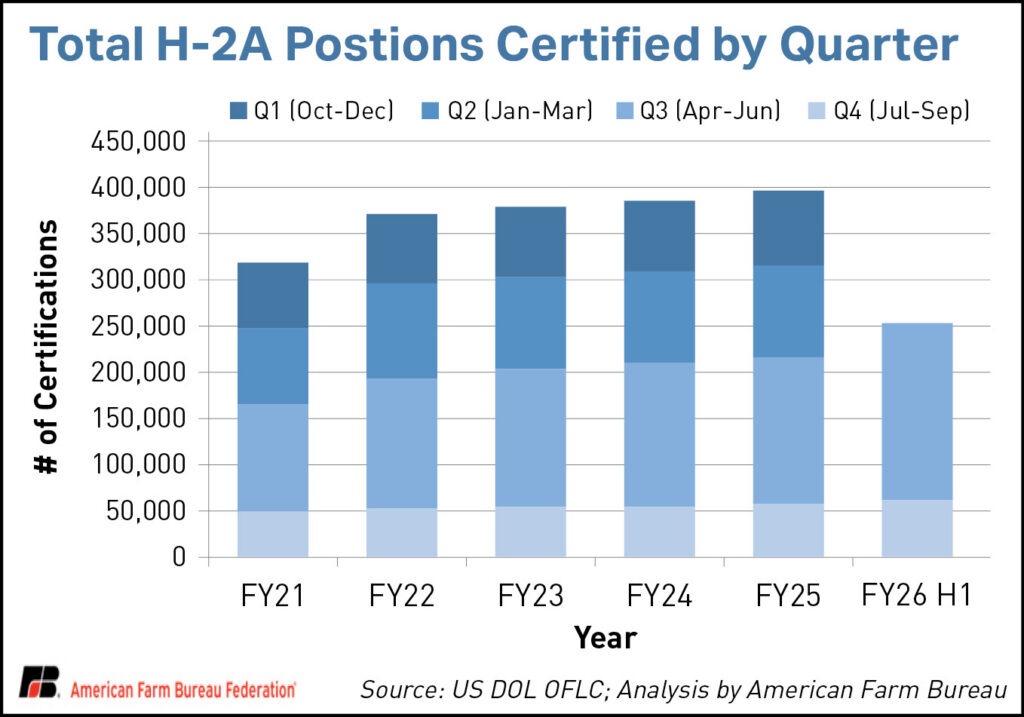
Annual H-2A certifications have climbed in every fiscal year since 2012, with the first half of fiscal year 2026 already outpacing the entire first half of every prior year.
Growth in H-2A job certifications was slower in fiscal years 2023 and 2024, which can be partially attributed to a costly 2023 disaggregation rule that required farmers to break job duties into separate applications and pay employees for jobs they might not always perform. The rule was vacated by a federal court in August 2025, leading to a sharp acceleration in demand for authorized workers via the H-2A guest worker program.
The second quarter of fiscal year 2026 had 192,000 positions certified, a 20.5% jump over the second quarter of fiscal year 2025 (159,554) and the highest single-quarter jump on record.
Quarter one of fiscal year 2026 also posted a gain, reaching 62,367 — up 7.1% from the first quarter of fiscal year 2025. Together, the first half of fiscal year 2026 totals 254,688 certified positions, a 16.9% increase over the same period last year and 19.2% above fiscal year 2024’s first half.
The certification rate has held steady throughout, with 97.6% of requested positions receiving approval in the second quarter of 2026, consistent with the 97%+ rate seen in every year since 2021.
Broad H-2A usage gains across the country
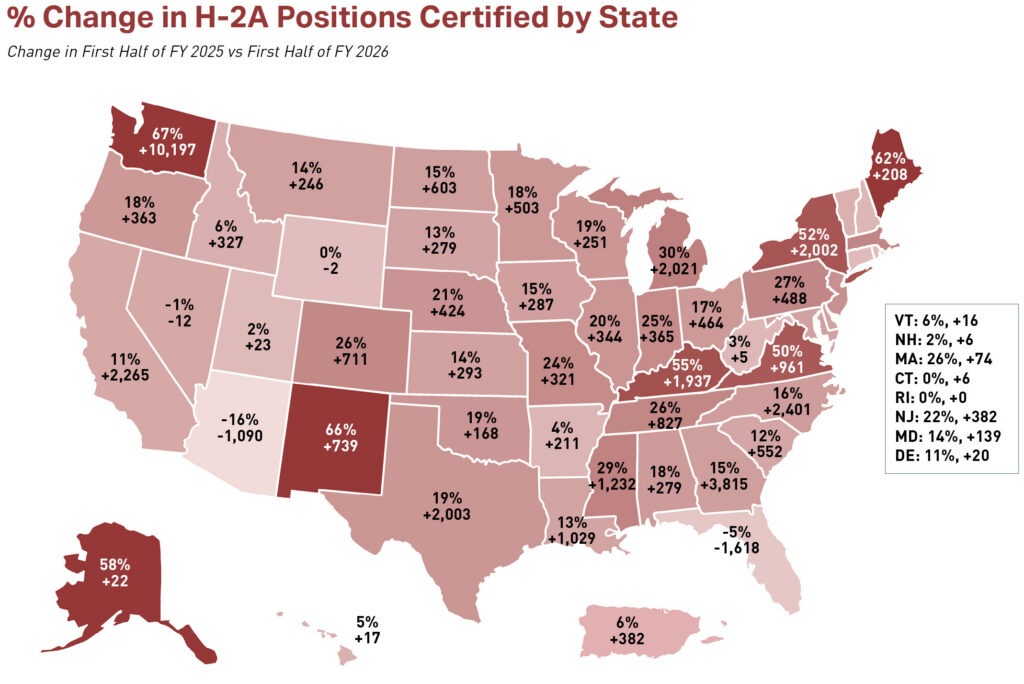
The growth story is not confined to any one region.
As the state-level map illustrates, the vast majority of states posted positive first-half changes from fiscal year 2025 to fiscal year 2026, with an overall average national increase of 5.7%. While a handful of states in the Southeast and along the West Coast saw modest declines, 43 of 50 states expanded their H-2A use during the first half of fiscal year 2026.
Among the states with the highest totals of certified H-2A positions:
- Washington posted one of the most striking gains, with first-half certifications rising 67% from 15,171 in the first half of fiscal year 2025 to 25,368 in the first half of fiscal year 2026.
- Georgia also had strong growth (+15%), while Florida, despite remaining the top state in overall certifications, posted a modest first-half decline of 5%.
- Through the first half of fiscal year 2026, Florida had certified 30,044 positions, already 52.8% of its full fiscal year 2025 total of 56,934.
The top five states dominate, but the composition is shifting
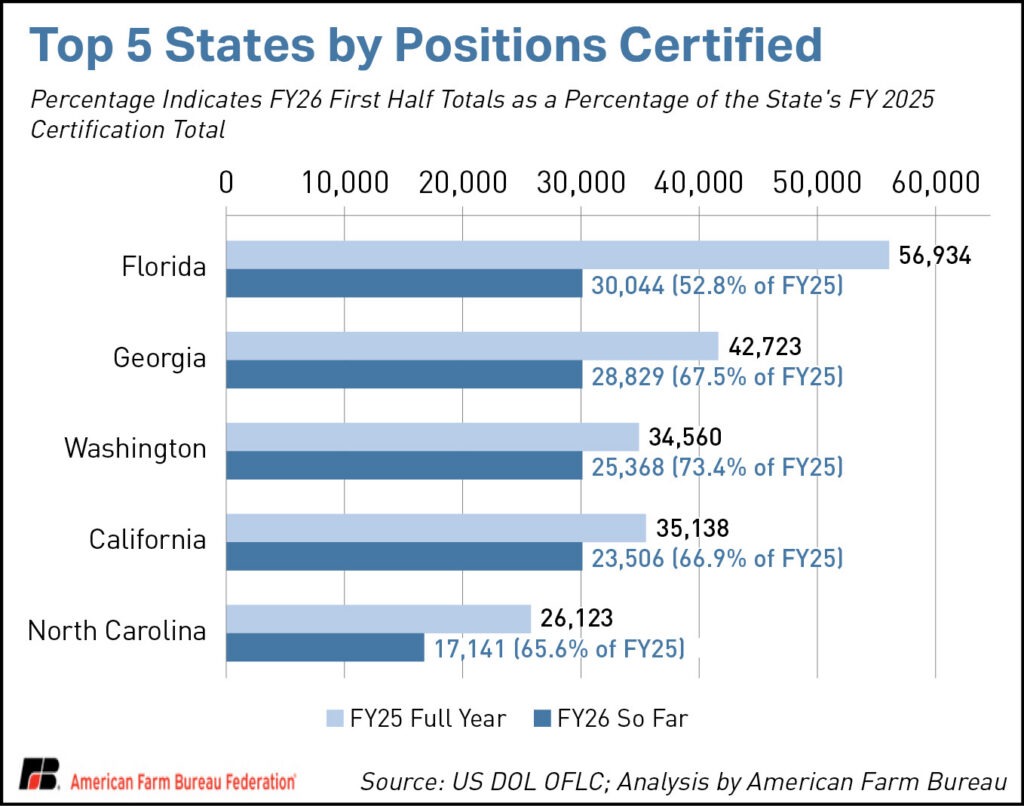
Florida, Georgia, Washington, California and North Carolina continue to account for a disproportionate share of total H-2A activity. These five states together certified nearly 125,000 positions in the first half of fiscal year 2026, representing just under 50% of the national total.
Notably, Washington has overtaken California for third overall in certifications for the first half of the year, a reversal of the states’ standing in recent full-year totals. California’s relative H-2A use has declined for three consecutive years, a trend that may reflect that state’s evolving regulatory environment and shifts in agricultural production mix.
Georgia’s total of 28,829 for the first half of the year puts it within striking distance of Florida despite Florida holding a substantial lead in fiscal year 2025’s full-year count, a sign that Georgia’s H-2A market is rapidly expanding.
The percentage labels on the accompanying map show each state’s fiscal year 2026 first-half total as a share of its fiscal year 2025 full-year certification. Washington’s 73.4% is the highest among the top five states, suggesting it has already secured nearly three-quarters of last year’s total in just six months and may end fiscal year 2026 well above its fiscal year 2025 level.
Looking ahead
In the third and fourth quarters of fiscal year 2025, 180,491 positions were certified in total. If fiscal year 2026 keeps a similar back-half pace, full-year certifications would approach 435,000 — roughly a 9% increase over fiscal year 2025 and a new program record.
The nullification of the wage disaggregation rule, which had driven up per-application costs and incentivized narrower job descriptions, may be contributing to renewed momentum.
Another potential explanation for increased program utilization is the Department of Labor’s Interim Final Rule that went into effect in October 2025. The rule allows employers to pay their H-2A employees under a dual-tiered wage structure and to deduct the costs of guestworker housing and transportation from workers’ hourly wages. As a result, H-2A employers in most states saw a decline in the federally mandated Adverse Effect Wage Rate for temporary farm employees.
The domestic labor conditions that have long underpinned H-2A growth remain unchanged. U.S. unemployment has been steadily low (4.3% in May 2026), and domestic interest in seasonal agricultural work remains negligible.
In fiscal year 2025, only 182 of the nearly 415,000 advertised temporary agricultural work positions were filled by a domestic applicant, representing just 0.0004%.
As long as these fundamentals hold, American farmers will continue to turn to the H-2A program as a primary tool for securing the workforce needed to make it through the crop year.
FAQs
What is the H-2A program?
The H-2A program allows U.S. agricultural employers to hire temporary foreign workers when domestic labor is unavailable.
How much did H-2A certifications increase in 2026?
Second-quarter fiscal year 2026 certifications increased 20.5% over the same period in fiscal year 2025, while first-half certifications rose 16.9%.
Which states certified the most H-2A positions?
Florida, Georgia, Washington, California and North Carolina recorded the highest numbers of certified H-2A positions.
Why is H-2A use continuing to grow?
The article attributes growth to persistent domestic labor shortages, regulatory changes and continued demand for seasonal agricultural workers.
What is the projected total for H-2A certifications in fiscal year 2026?
If current trends continue, full-year certifications could approach 435,000 positions, setting a new program record.
Cameron Castillo, a native of Las Cruces, New Mexico, is an associate economist with the American Farm Bureau Federation. His professional background includes serving as a Public Policy Assistant at AFBF and as a legislative aide in the Texas House of Representatives. He can be reached at cameronc@fb.org