

Skysense Drones Take Flight Against Bird Damage in Fruit Orchards





Written by Heidi Pitts
(Sponsored) Harvest season is coming. For growers of blueberries, cherries, apples, and other high-value crops, tight labor, thin margins, and relentless bird pressure are constants. With bird damage costing the U.S. fruit industry hundreds of millions of dollars annually — running as high as 27% of sweet cherry yield in some studies — protecting orchards and fields is not optional.
The problem is that most traditional methods fall short. Barrier methods like netting require significant investments in time, labor, and equipment that may be impractical for many operations. Bird kites, sound cannons, and flashing lights provide inconsistent protection and lose effectiveness as birds habituate to their presence. For many growers, the search for a reliable, low-labor solution has been a long one.
Skysense AI was built to answer that need. Supervised autonomous drones patrol from sunup to sundown on customized flight plans, combining AI targeting, proprietary sounds, and flashing lights to keep birds out of fields and orchards all season long. Drones launch from an on-site charging dock requiring only a level surface, electricity, and an internet connection to install, and are engineered to operate in light rain and winds up to 35 mph without any intervention from the grower.
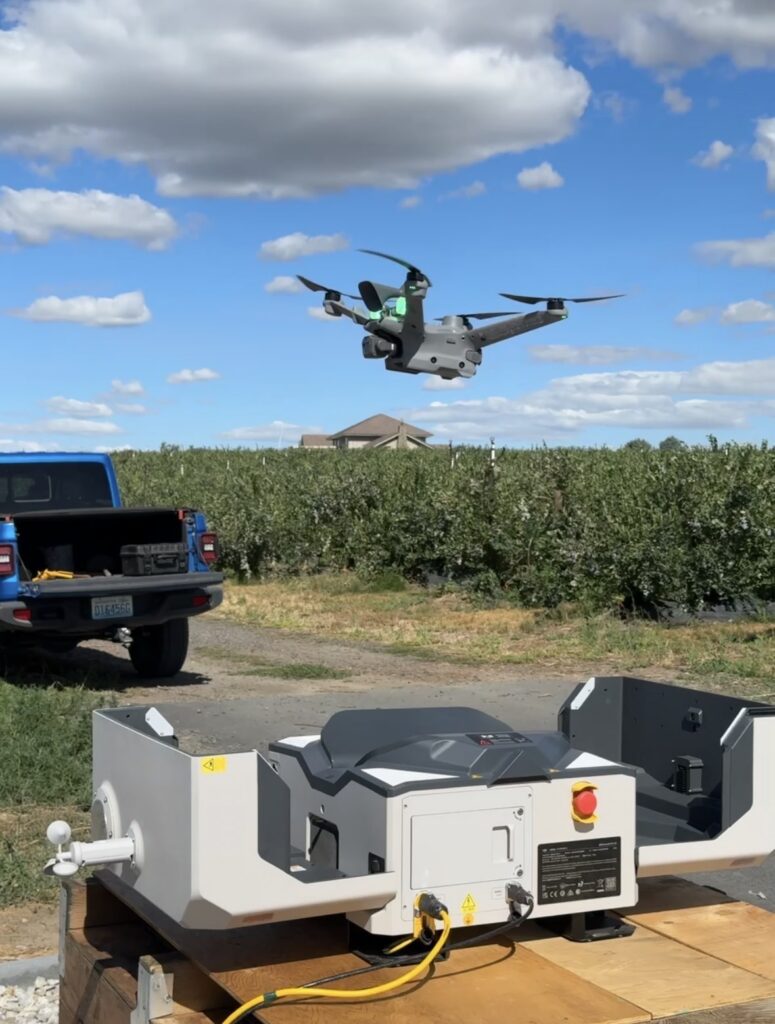
“The concept of Skysense grew out of time working on my dad’s farm,” says CEO Justin Clune. “I wanted to find better ways to protect crops.”
The real differentiator is Skysense’s team of certified drone pilots, who do far more than remote monitoring. Operating from the company’s office in Kennewick, Wash., pilots study the behavior of bird species specific to each location, map orchard risk factors — such as proximity to night roosting sites or isolated blocks with minimal human activity — and build flight plans designed to prevent birds from entering fields in the first place. When birds are spotted, a pilot takes manual control to drive them out of the area entirely.
That combination of automation and human expertise also allows for ongoing refinement. Jamie Baird of Baird Orchards in Royal City, Wash., has deployed the Drone-in-a-Box system across his cherry and apple blocks for two consecutive seasons and is returning for a third. Early on, Baird and the Skysense team collaborated to test and adjust which bird sounds proved most effective, and they adapted flight patterns to account for obstacles like wind machines. Keeping patrol routes varied, Baird notes, is important: birds can habituate to repetition, so unpredictability is part of what makes the system work.
Baird also values what the technology does not require. “I love that they’re all electric,” he says. “I like that it’s not using fossil fuels, partly because of climate change but also because it’s extremely low maintenance and you don’t have unexpected costs as gas prices climb.” At a time when oil and gas price volatility is increasing operational costs across agriculture, an all-electric system with minimal moving parts offers a meaningful hedge against unpredictable expenses.
Patrick Dorsing of Royal Ridge Farm in Othello, Wash., reached a similar conclusion in his blueberry operation after trying multiple mitigation tools. Setup was straightforward — a level area next to power and a field map were all the Skysense team needed to get the system running. Over four weeks of use, the drone remained an effective deterrent for the entire harvest season.
“Skysense allowed us to focus on harvest operations while knowing our fruit crop was being actively protected,” Dorsing says. “I’m planning to just use Skysense and remove all other bird mitigation tools. I think it works better than the rest combined.”
For fruit growers heading into harvest with familiar pressures and shrinking tolerance for crop loss, Skysense’s Drone-in-a-Box offers a solution that runs on its own, improves over time, and keeps the birds out.
Learn more at skysense.ag
© 2026 Skysense