

5 questions with Michigan’s new tree fruit IPM extension educator Martin Brubaker
Brubaker is a native of Lowell, Michigan, and he joins us to discuss pest management, grower outreach, H-2A workers and his goals for Michigan’s fruit industry.






Growers in West Michigan might notice a new face roaming the gently rolling, commercial orchard dotted hills of the famous Fruit Ridge region: Michigan State University Extension recently brought on Martin Brubaker as its new tree fruit integrated pest management (IPM) extension educator.
Brubaker is already up-and-running in his new role, where he’s based in Kent City at the MSU Extension office with a coverage area encompassing Kent, Ottawa, Barry and Ionia counties.
According to an Extension blog post announcing his appointment, he will “support the state’s tree fruit industries with pest and disease management through grower engagement, educational programming and collaboration with commodity partners, industry stakeholders and MSU research faculty.”
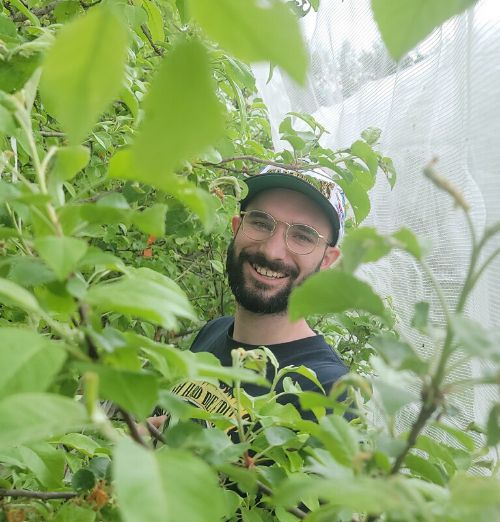
Photo courtesy of Michigan State University.
Brubaker is a native of Lowell, Michigan, and he earned his M.S. in entomology at Michigan State University (MSU) where he worked with Julianna Wilson, PhD, on woolly apple aphid management.
While both his educational and research backgrounds are solid, perhaps most notable is the fact that Brubaker spent time working on several commercial farms and orchards throughout the Wolverine State, including Bayfield Apple Company, Phillips Orchard and Cider Mill and as a trials grower at Walters Gardens working with ornamental plants.
Brubaker also brings fluency is Spanish to his role with MSU Extension, a skill that will serve him well in working with Michigan’s growing H-2A workforce.
We caught up with Brubaker via email to ask him a handful of questions to help growers learn more about the “new guy on the block” in Michigan’s Fruit Ridge area:
Fruit Growers News (FGN): It sounds like you have experience managing spotted wing drosophila (SWD) and assessing management strategies for blueberry maggot, oriental beetle and other berry crop pests. What’s the latest info about these pests or just IPM in specialty crop farming in general, that you think growers should be aware of today?
Martin Brubaker (MB): The last projects I was working on with the SWD were related to parasitoid wasps and their role. SWD can continually reinfest orchards from wooded edges, and these wasps may provide a potential way to lower reinfestations. I also helped collect blueberry maggot for a few years to look at how their emergence may be shifting. The Isaacs Lab at Michigan State is always doing great applied work.
FGN: You’ve spent a portion of your career doing manual labor on working farms. What do you take from those experiences that you bring into your role at MSU to better connect with and understand the issues farmers are facing in Michigan?
MB: One of the benefits of not knowing what you want to do when you’re younger is you get to work in a lot of different places and gain a wide range of experiences. I didn’t necessarily think working on my friend’s dad’s farm would become important career experience. One useful skill I learned was how not to get on the bad side of my farm managers. I try to work hard, ask questions, fix any mistakes I make and I always try to make the farm manager laugh. It took me three weeks to get a single chuckle out of one farm manager. I honestly thought I was gonna get fired for being annoying before I got him to break.
In terms of how I bring that to my work with MSU Extension, I’ve seen first hand that being a grower means being an expert in a lot of different jobs and most of those jobs take a lot of effort and time. So while I do joke around a lot, I try to respect that grower’s time is valuable and I would like to try and make sure anything is worth that time.
FGN: You’re also fluent in Spanish and plan to use that skill for outreach into Michigan’s farm worker community. What does that outreach effort look like as you start your role with MSU?
MB: Speaking Spanish has definitely been an asset when working in agriculture. I’ve worked alongside H-2A crews, and being able to translate tasks or provide guides in both English and Spanish has made life easier for everyone. The H-2A employees usually tease me because I root for Pumas UNAM, who are a pretty mediocre soccer team in Mexico’s Liga-MX (Editor’s Note: Pumas is currently ranked 12th overall in Liga MX). From an MSU Extension perspective, I’m still thinking through what this type of programming could look like. I believe there is a lot of potential for education and programming designed for farmworkers, especially if you have crews who return to the same farms year after year.
FGN: For you, what does success look like across your first 90 days in this role? And what are you hoping to accomplish longer term (say, the first year or two) that will help Michigan growers directly?
MB: In the immediate future, I want to meet growers and others working in the tree fruit industry. Over the longer term, I hope to identify how MSU Extension and I can best support the region’s integrated pest management needs. That includes learning which past Extension services growers found useful and identifying new ways to provide practical, relevant support.
FGN: Anything else you’d like to share with our audience of Michigan fruit and vegetable growers?
MB: I feel very lucky to be able to work in ag extension. I come from an extension family and this job and this institution mean a lot to me. I’m gonna try my best to be of service to tree fruit fruit industry. Second, If you see a text or get a call from someone with my name, I promise it’s not spam. You can also reach me at brubak40@msu.edu. Lastly, I’m a superfan for the Pittsburgh Steelers, and I want your audience to know that this year is our year.