

Q&A: New USHBC board chair Ellie Norris talks Mexican berries, job priorities
We recently caught up with new USHBC chair Ellie Norris for a quick chat about her view of the role and priorities. Learn more about this fruit industry emerging leader.





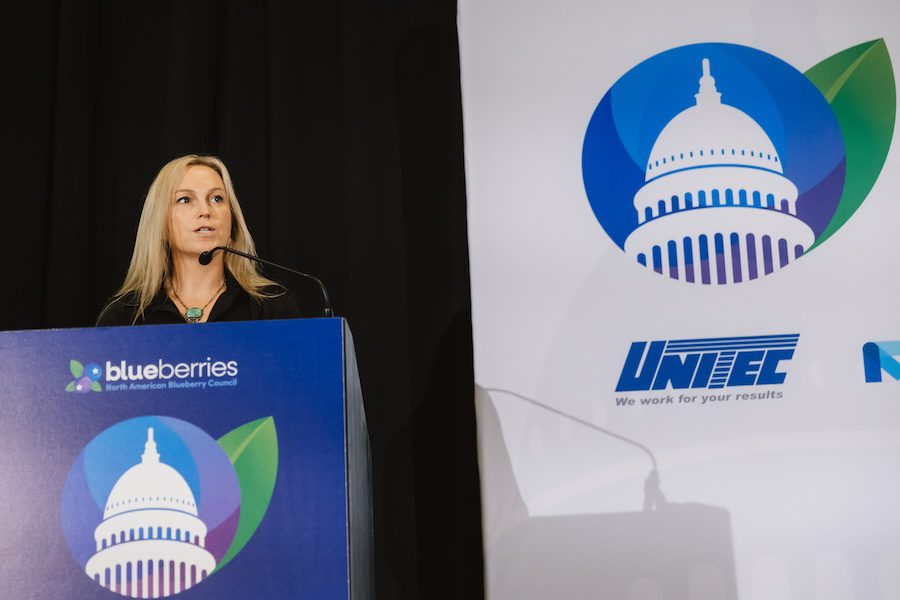
Secretary of Agriculture Brooke Rollins recently announced the appointment of 23 members and alternate members to serve on the U.S. Highbush Blueberry Council (USHBC) board, according to a USHBC press release.
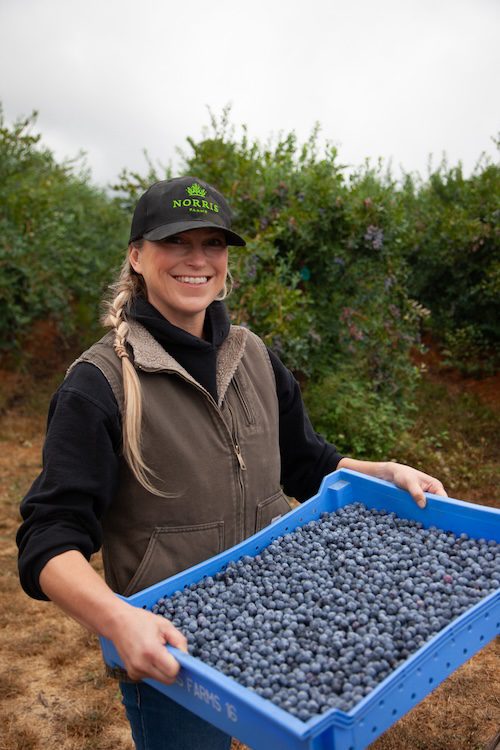
Rollins also approved the board’s new chairperson, Oregon farmer Ellie Norris. Norris, age 40, leads her families’ farm, Norris Blueberry Farms (Roseburg, OR), alongside her older sister Carrie Norris (43).
The farm, which today sits at 650 acres along with an on-farm packing house with six sorting and packing lines, began as a hobby for Norris’ parents, Paul and Sandy, during the mid-1980s on just 5 acres. According to a Capital Press article, Norris Berry Farms now consists of 400 acres of organic blueberries, 250 acres of conventional blueberries and 18 acres of kiwi berries. On a peak day, 180,000 pounds of berries can be sorted and processed.
Fruit Growers News recently caught up with Norris on the heels of her appointment to learn more about what she’ll bring to the role and her priorities for the USHBC board:
FGN: You grew up on a family farm and also worked in marine biology and wildlife industries
before taking on this role. What will you bring from each of those two experiences to this
role?
Ellie Norris (EN): As your readers know, growing up on a family farm gives you a very practical perspective. You understand risk, long timelines and what it takes to build something that has to last. You also develop a deep respect for the people – Mom and Dad in my case – doing the work and overcoming the challenges they face every day. I’m passionate about family farms and sustaining that way of life for those of us who love it.
My background in marine biology and wildlife work brings a different lens. It trained me to think in systems; to understand how small changes can ripple across a larger environment; and to rely on data, observation and adaptability. That perspective is valuable in an industry that’s becoming more complex and more global. Bringing those together, the goal is to stay grounded in the realities of growers, while also helping the industry think ahead and adapt to what’s coming.
FGN: The effects of imported berries from Mexico and other countries is a major topic of discussion among berry growers. Do you plan to address this issue during your tenure and if so, can you share details of your plan?
EN: It’s an important conversation, and one that deserves to be handled with a lot of care and clarity. When the industry came together to form USHBC 25 years ago, it was with a very specific purpose in mind, which was to grow demand for blueberries and build a stronger, more resilient category. Our work has never been more important than it is today.
Consumers now expect to find blueberries year-round. That shift didn’t happen by accident. It’s the result of sustained investment in USHBC’s marketing, research and positioning of blueberries as an everyday item rather than a seasonal one. A year-round category requires a reliable, continuous supply—integrating domestic production and imports to consistently deliver high-quality, great-tasting blueberries and meet growing consumer demand every day of the year.
The role of USHBC is not to manage or restrict supply. It’s to continue building demand so the category can support that supply. In many ways, we are in the business of finding a home for every berry. That means staying focused on high-impact marketing and advertising, credible health research and global market development efforts that keep blueberries relevant and demand-growing with consumers. At the same time, there’s a role for industry organizations like the North American Blueberry Council (NABC) to stay engaged on trade policy and ensure a fair and functioning system for growers.
The path forward is not about choosing between domestic and imported fruit. It’s about making sure the category continues to grow in a way that creates opportunity for growers here at home, while meeting the expectations of today’s consumer and our retail partners.
FGN: What priorities would you like to steer the U.S. Highbush Blueberry Council toward tackling during your term, and why? What would you hope to accomplish in this role to be able to walk away fulfilled at the end of the term?
EN: At the center of it is growing demand. That has been the purpose of USHBC since it was created, and it remains the most important lever we have as an industry. We are no longer a seasonal crop. Blueberries have become a year-round item, and that comes with both opportunity and responsibility. If supply continues to expand globally, demand has to keep pace. Otherwise, the pressure shows up quickly at the farm level.
That’s where USHBC plays a critical role. Continued investment in promotion that resonates with today’s consumer, nutrition research that reinforces why blueberries matter, and data that helps guide smarter decisions across the industry all contribute to strengthening the category. It’s not just about doing more, it’s about being disciplined and effective in how those efforts are executed. USHBC is the only organization that focuses on growing the pie so that individual slices have the potential to be bigger for everyone in the blueberry business.
Another priority for me is to continually create clarity and trust within the industry about the work of USHBC. There can be misunderstandings about what USHBC is and is not designed to do. Making sure the industry understands that this organization exists to grow the entire category and is independently and continually evaluated for its effectiveness is essential. Since its inception, USHBC was formed and funded by growers and importers, and is mandated by USDA to represent blueberries of all origins equally. Growers make up the majority of the board, and continue to be at the table to direct, approve and assess USHBC’s work. This is our organization.
At the end of the term, success would look like an industry that is aligned around the role of USHBC and confident in the direction we’re headed because the results are evident, as well as the opportunities for people to build the business, life and legacy they want. This work doesn’t stop with one term, so the goal is to help strengthen that foundation and carry the momentum forward for the industry long after.
FGN: Were you surprised by your nomination and appointment to this position?
EN: It wasn’t a surprise, but it is an honor and not something I take lightly. The blueberry business, including my time working with USHBC, has given me the opportunity to be involved at a number of levels, from the farm to marketing to nutrition policy conversations. That perspective, along with a willingness to listen and engage across different viewpoints, hopefully puts me in a position to bring value to all those we serve as an organization.