

Washington orchard frost protection strengthened by AgWeatherNet
Frost protection is critical for orchards. Learn how Washington State’s AgWeatherNet helps growers improve frost protection with inversion forecasts and other precision tools.





Because Central Washington lies between the Cascades and the Rockies, cold air often settles in the state’s central basic. Sloping tree fruit orchards also trap cold air, forcing growers to prioritize Washington orchard frost protection. Apple, cherry and pear orchards in these areas remain especially vulnerable to frost damage.
Forecasting beyond the National Weather Service
Basavaraj Amogi, a Washington State University (WSU) postdoctoral research association, explained during an October 24 webinar that small regions with complex terrain aren’t accurately captured by National Weather Service (NWS) forecasts. To address that, WSU’s Irrigated Agriculture Research and Extension Center in Prosser created AgWeatherNet (AWN), a system of more than 350 weather stations.
Sean Hill, AWN systems analyst and applications developer, said the platform improves on NWS forecasts and helps detect temperature inversions, when air temperatures increase with height. “Our models outperform NWS forecasts by 32% on average,” Amogi said.
How AgWeatherNet helps growers manage inversions
AWN operates 53 tower stations, with 24 already providing inversion forecasting. Over time, more towers will be added, and by 2026 AWN expects to operate 100 tower stations. Amogi noted that to enable forecasting, each station needs at least one year of data to train machine learning models.
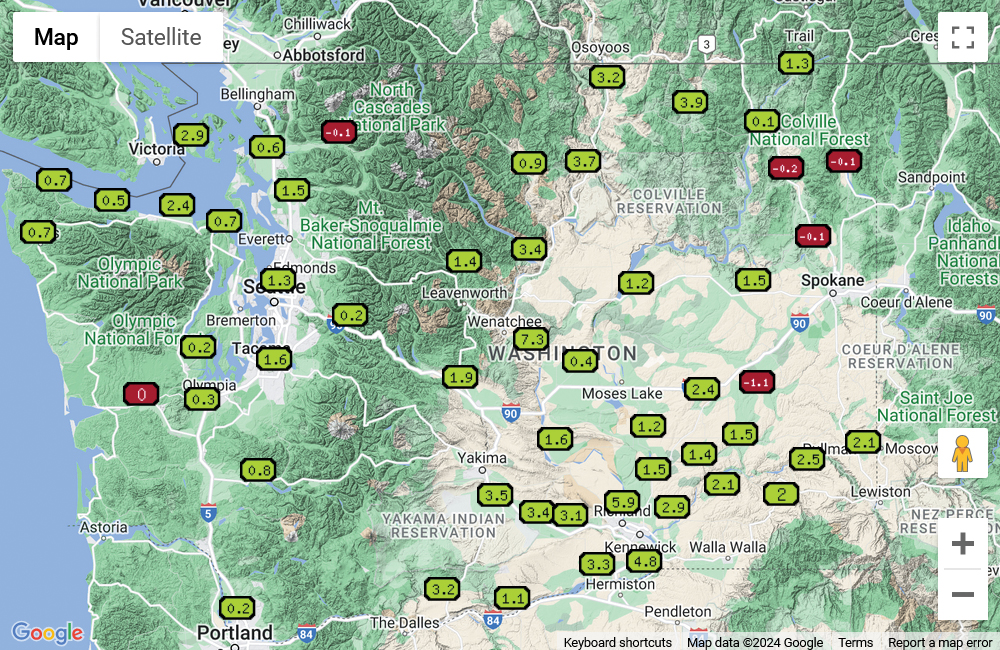
“In a strong inversion, the wind machine becomes more effective,” Amogi explained. “If the inversion is two degrees, we can expect plant tissue temperatures to rise by about one degree.”
He added that drones could also help measure inversion layers. “If the air is already well-mixed, wind machines will be less effective, but we can still use them to move cold air away from the orchard canopy,” Amogi said.
Tools for frost protection in cherry orchards
Most Central Washington cherry orchards sit on slopes, where cold air sinks and threatens buds at different growth stages. To protect them, growers use wind machines, smudge pots, and sprinkler systems.

“Rotating 360 degrees, wind machines mix warm and cool air, pushing warmer air toward the ground,” Amogi said. “That circulation keeps orchard air warmer.”
Smudge pots, however, are harder to manage, and sprinklers can fail, posing higher risks if temperatures drop overnight. AWN’s inversion forecasts help growers decide when to run wind machines, reducing wasted fuel and ensuring protection at critical times.
Toward integrated tools for growers
Hill said AWN researcher are also developing a spray guidance tool to help growers know when to spray, when not to spray, and when to proceed with caution. “I’m personally interested to see how inversion data interacts with air quality sensors and how we can present that information more clearly to growers,” he said.
By combining inversion forecasts, real-time monitoring and practical tools, AWN continues to advance Washington orchard frost protection, giving growers more precise ways to guard against damaging cold air.
— Doug Ohlemeier, Assistant Editor