

High-density systems, PGR trials and harvest innovations headline IFTA’s Winter Tour
Attendees toured five innovative Central Valley farms in February. Read on for take-home ideas you can apply to your own orchard this season.





This year’s International Fruit Tree Association (IFTA) winter tour departed from downtown Fresno, Calif., and visited five commercial farms throughout the state’s highly productive Central Valley, a region where almond, berry and stone fruit plantings literally stretch as far as the eye can see.
Growers across this sun-drenched valley operate within some of the strictest farming regulations and highest labor costs in North America while tending their crops, most of which are hand harvested, year-round in soils that vary from sandy loam to deep, well-drained clay.
As previously stated, the day featured five stops, each with a lesson grower-attendees could take home to their operations around the U.S. and the globe.
Sangha Farms, Del Ray
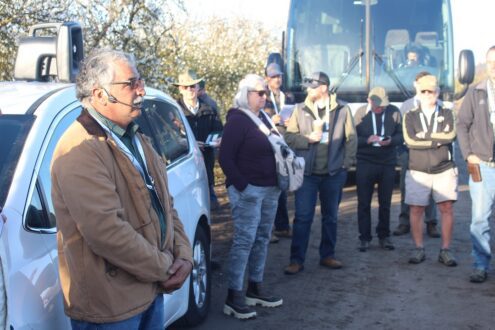
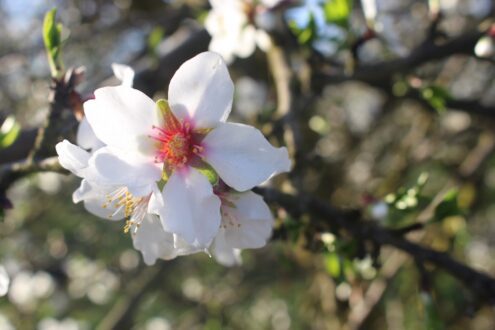
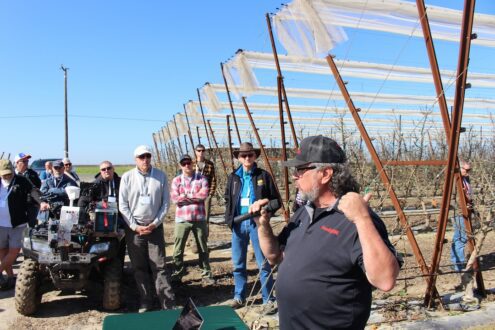
This third-generation family farming operation was the tour’s first stop for the day. Grower Mitch Sangha (pictured above left) and Valent USA senior product development manager Jozsef Racsko walked attendees through the various PGR field trials taking place across the farm’s 50 acres of ‘Tioga’ and other proprietary varieties of sweet cherries.
Sangha and his team are trialing to unlock the precise combination of PGR active ingredients and application timing to both initiate tree dormancy and then break the trees out of slumber for early harvesting.
Kings Orchards, King County
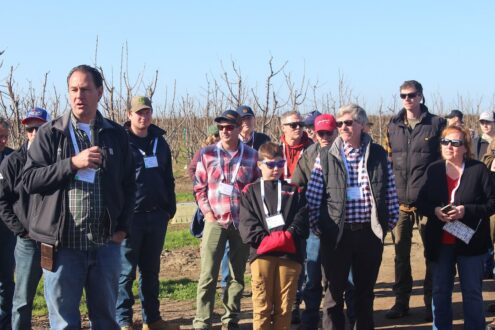
“For us, getting the right color is the top consideration; if we don’t get the proper color we won’t put it in the box,” he said. “And our approach to labor is simple: we pay $5 a [harvested] tote, and they just show up. [Finding] labor is not that difficult for us as long as there is enough crop, because at that price the workers know they can make good money.”
Warmerdam also walked the group through his neighbor’s 4-scaffold V-trellised nectarine and pear plantings.
Family Tree Farm, Reedley
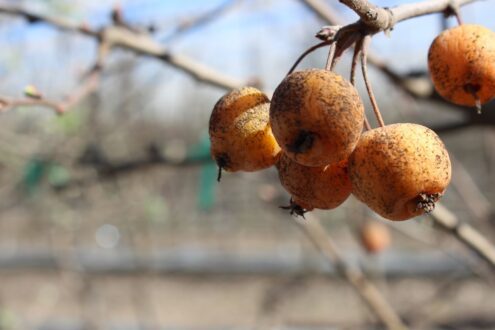
At the tour’s third stop, attendees walked the farm’s ‘Sugar Burst’ low-chill apple plantings as its soon-to-be-retired R&D director Eric Wuhl (pictured above left) explained how the variety is one of the earliest maturing apples in all of California.
“It holds very well in cold storage, and it will color up nicely in full sun,” Wuhl told the group. “It’s a very unique variety — there’s no other apple picking within two weeks of this variety, and we’re also growing it on farms in South Africa and Europe.”
Family Tree is a unique agribusiness in that four families make up its ownership group, with each family maintaining its own growing operation. Once the fruit is harvested — the company also grows peaches, apricots, plums, nectarines and Bradford pears — it is shipped, packed, sold and marketed at the farm’s packout operation in Reedley proper.
The Grapery, Shafter
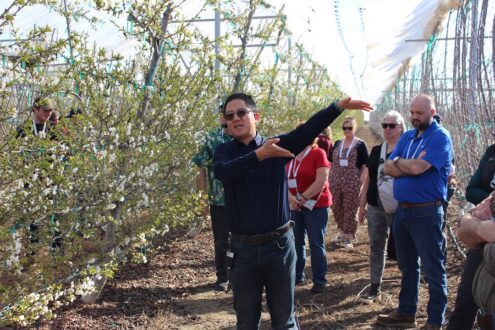
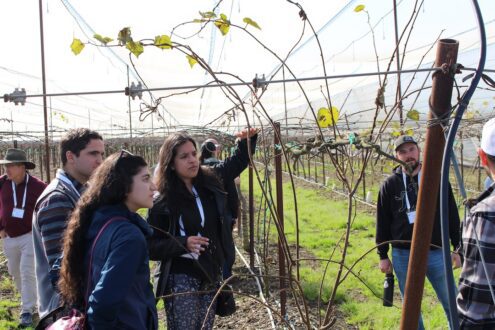
The day’s fourth stop was perhaps its most intriguing, as the group walked The Grapery’s low-chill, high-density trellised upright fruiting offshoots (UFO) experimental cherry plots.
Viticulturist Yi Zhang (pictured above left), a former Ohio State University horticulture student who now heads up production for the farm’s owners, Pandol Brothers, said there were several things his team would do differently now that they have more experience in the system.
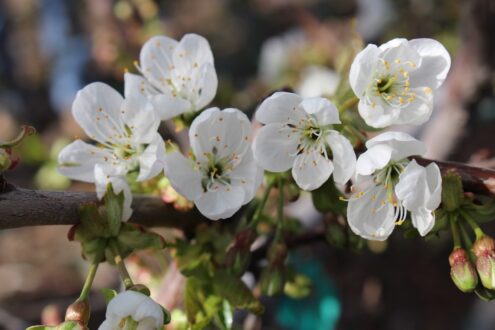
“Next time we will have the guys train [branches] flat or downward, and we will also raise the lowest branch level,” he explained, adding that the ‘Cupid’ variety planted in the system was too vigorous and overall uniformity “wasn’t great.”
HMC Farms, Kingsburg
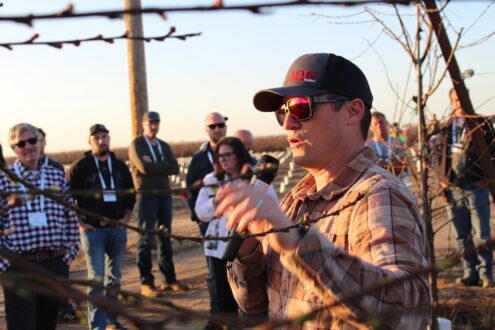
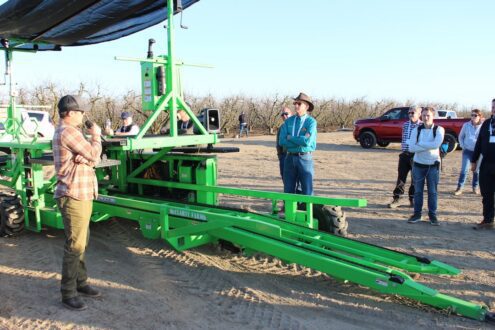
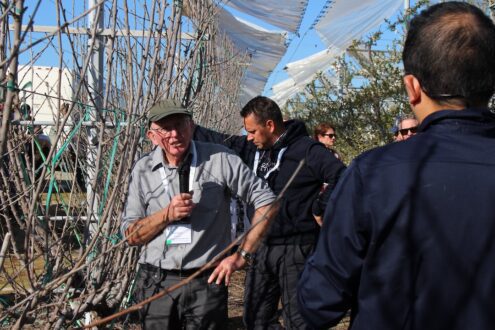
To close out the day, the group swung by HMC Farms on the way back to Fresno to hear from growers Jon McLarty (pictured above left) and Drew Ketelson on the farm’s high density, narrow training system and how it’s allowed them to be more efficient in both thinning and harvesting 6,000 acres of stone fruit.
Several technologies were featured, including a custom tractor-driven thinning machine and a six-worker harvesting and pruning platform (pictured above right) that McClarty says his crews were wary about working on at first, but the adjustable, pull-behind platform has since become his worker’s favorite machine.
“It’s safer than using ladders, and the guys are more efficient and less exhausted at the end of the day — they even joked with us that they could go get a second job now because they weren’t so tired from climbing up and down ladders all day,” McLarty explained.
HMC is also working with Israeli startup Tevel Aerobotics Technologies’ autonomous fruit harvesting drone system and is hoping the company returns to the farm this summer to deploy its fruit picking flying robots to help harvest its peach and nectarine plots.
RELATED – IFTA summer tour shows Canadian tree fruit methods
RELATED – IFTA Yakima Valley tour provides orchard insights
Industry News