

Misshapen strawberries caused by poor pollination





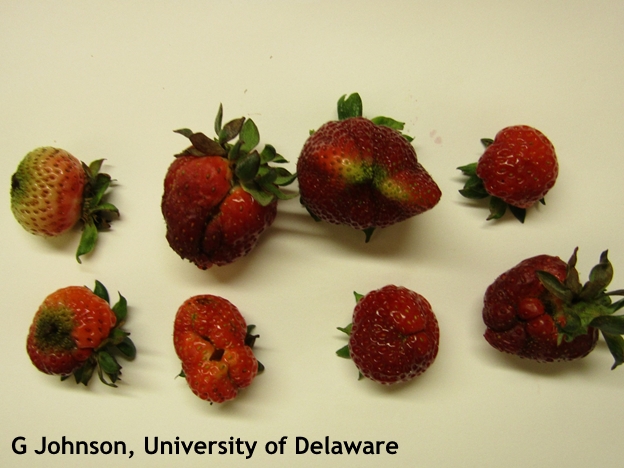
To have the largest berry possible, you need as many of these ovules to be successfully pollinated as possible. To avoid misshapen fruits the achenes need to be pollinated evenly and fully. With pollination, the receptacle tissue around the achenes will develop to form the strawberry fruit.
Strawberries have both male and female flower parts on the same flower and can self-pollinate. Wind and rain can move pollen within the flower. However this usually does not allow for full pollination of all the ovules. Bees, such as honey bees or bumblebees, are usually necessary to allow for complete pollination. Some flowers actually produce bigger berries when cross pollinated with pollen from other flowers. Incomplete pollination will often result in smaller or misshapen berries.
Strawberry flowers are not heavy nectar producers. However, bees do visit the flowers and studies have shown that where native bees are limited, adding hives of honey bees or bumble bees increased productivity. It is recommended that each flower receive 16-25 bee visits. This is particularly true of the king berries, which form from the first flower to open on a fruiting truss.
Lygus bugs (Tarnished Plant Bugs) can also cause misshapen fruit by feeding on the flower. To distinguish between Lygus bug damage and poor pollination look at the seed size on the fruit – seeds on fruit affected by Lygus will be similar in size.
Boron deficiencies are another potential cause of misshapen strawberries.
– Gordon Johnson, Extension Vegetable & Fruit Specialist; gcjohn@udel.edu