

Natural enemy of invasive, berry-eating SWD found in US





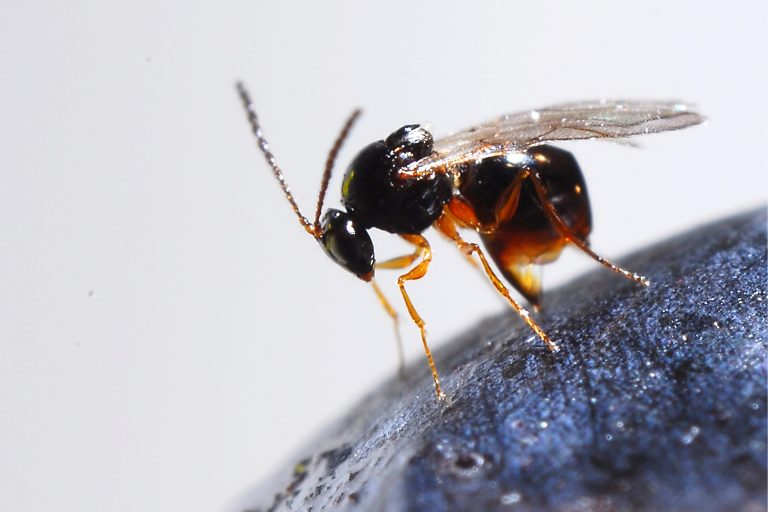
The drosophila flies cause major damage to several Washington crops, especially sweet cherries and berries. The wasp, which lays its eggs in the flies, could be a means of controlling their spread.
“This is really a positive step for the cherry and berry industries,” said Elizabeth Beers, a professor in Washington State University’s (WSU’s) Department of Entomology. “Hopefully this speeds up the timeline to get biological control of the spotted-wing drosophila.”
Beers and her team found the parasitoid, called Ganaspis brasiliensis, this September, in a wild blackberry patch less than a mile from the Canadian border near Lynden, Washington. The tiny wasp was found in western British Columbia in 2019. Paul Abram, a Canadian colleague, asked Beers to watch for wasps crossing the border and provided tips on the best places to find them.

The invasive drosophila fly hurts fruit because it doesn’t just nibble on the outside—its larvae burrow down into a raspberry or cherry and ruin the entire thing. That’s where the parasitoid comes into play.
Beers said it’s just possible to see the tiny adult parasitoids flying around drosophila-infested fruit. The female Ganaspis then lay their eggs inside the drosophila larvae. The little parasitoid develops inside the drosophila larva, killing it in the process.
The Ganaspis parasitoids were recently approved by the U.S. Department of Agriculture Animal and Plant Health Inspection Service to be reared and distributed around the U.S. as a biocontrol.
To do that, an entomologist went to the native home of spotted-wing drosophila, found the Ganaspis, and brough back several samples. After significant research in quarantine, it was found to be safe to spread here to fight drosophila.
During that process, the Ganaspis found its own way to North America and is spreading without help. Once an invasive species is found living in a state, the USDA does not regulate it being distributed around that state, making the process easier.
“It’s kind of the best of both worlds,” Beers said. “It’s great that we have a lot of research showing that Ganaspis is very host-specific and safe to spread around. But there are also benefits to it being found here in nature.”
This is the third exotic species that Beers and her lab has found in the last few years. They found a parasitoid of the apple mealy bug, a pest for the apple industry, and the Samurai wasp.
“I never anticipated this, it’s not the main focus of our lab,” Beers said. “We’ve just kind of stumbled across them as part of our research on various pests.”
Post-doctoral researcher Dylan Beal and technician Peter Smythemann led the work collecting and rearing the Ganaspis.
– Washington State University
Photo at top: A parasitoid wasp, Ganaspis brasiliensis, laying eggs into the larva of a spotted-wing drosophila on a blueberry. Photo: Kent Daane/UC Riverside