

Tools that pay: How Okanagan Specialty Fruits saved $2,000 per acre with futuristic orchard ag tech
Learn how Okanagan Specialty Fruits integrated autonomous tractors, smart sprayers and orchard vision systems.





The Okanagan region in British Columbia is considered one of Canada’s oldest and most important fruit growing regions. Commercial fruit production started amid the region’s sun-drenched mountain peaks and terraced river valleys in the 1890s and the area is believed to be the birthplace of Canada’s cooperative fruit marketing sector with the birth of the Kelowna Shipper’s Union in 1895.
Today, the many commercial fruit packing houses that call this picturesque vineyard and orchard dominated landscape home are known for their vivid, eye-catching crate labels, some of which are considered treasured Canadian art.
One of the region’s leading grower-packer-shipper operations – Okanagan Specialty Fruits – recently integrated an impressive array of Ag Tech tools across its 1,250-acres of orchards clustered on the Royal Slope between Moses Lake and Royal City, Washington. The tech tools run the gamut from autonomous tractors and sprayers to smart spraying and irrigation tech to precision crop load management via passive data collection tech like Vivid Machines and Green Atlas orchard vision platforms.
RELATED – Inside CMI Orchards’ climate-positive tree fruit production strategy
The tech additions thus far have resulted in a substantial annual cost savings of approximately $2,000 per acre (including harvest expenses) while improving fruit quality and yields by an average of 25% to 40% while maintaining ideal produce size profiles.
Full integration
One distinction that set this project apart, according to orchard operations manager Joel Carter, is that the tech integrations mostly spanned the operation’s full acreage; only the Moleaer Nanobubble system is being trialed on a small section of apple trees. Everything else, Carter says, is now at the stage of full farm integration.
“If we’d just done all this over 20 acres, I could see other farmers kind of rolling their eyes and saying ‘Ok, but come back when you’re not a gardener,” Carter says . “But, you know, and I say this as someone who farms on 50 acres of my own – so I am the proverbial gardener up here – but I think we’re showing that this can be done at commercial scale.”
Tech that can scale is a critical selling point for any new Ag Tech solution, but it’s also criticalthe tech fits the current farm workflow and delivers a clear return-on-investment, and Carter considers both of those boxes checked off as the project moves into year two.
Here’s a quick breakdown of the technology Okanagan added in 2025 and how it’s benefitted the farming operation:
Autonomous tractors and sprayers
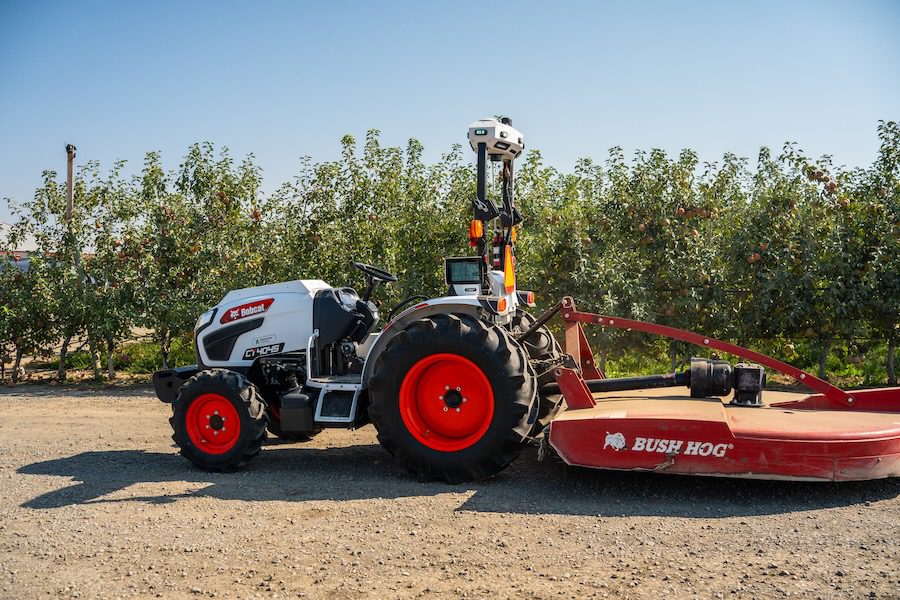
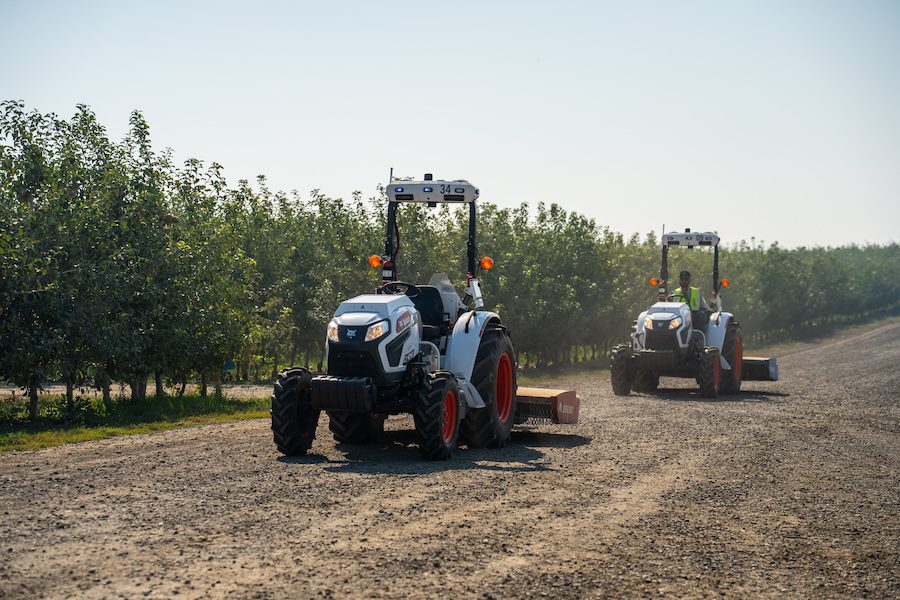
The team at Okanagan leveled up from three 46 hp Bobcat autonomous tractors used exclusively for mowing (shown above) to five 112 hp Kubota’s capable of carrying out multiple orchard tasks like foliar spraying, herbicide application, mowing, gopher baiting and variable rate fertility applications.
The shift enabled the farm to run their field tractors for 70-75 hours per week without having to pay overtime to equipment operators, and by having one worker tasked with running a nurse tank and refilling the pull-behind orchard sprayers the farm reduced sprayer downtime from 45 minutes per 80 minutes of spraying to 15 minutes and boosted average acres covered in a day from 16 to 20 to 24 in a typical workday, per tractor.
For small acreage that’s not a huge, seismic leap in efficiency, but extrapolated out across Okanagan’s 1,200-plus acres of orchards those small performance enhancements start to have a big impact on the farm’s labor costs and ability to cover acres.
The farm also upgraded their spray units themselves, adding two John Deere’s SmartApply see-and-spray LIDAR based spray systems and plans are in place to add a Turbo-Mist Orchard IQ smart sprayer control system this summer. Both systems use canopy maps to understand where the trees need to be sprayer and where they can get by without spraying, saving the farm money on chemicals and increasing its spray program efficiency.
“We have a lot of topworked trees, and grafted blocks,” said Carter. “So you do your scans and you find out your most uneven blocks…we specifically use the SmartApply units on our most inconsistent blocks and we saw savings from 10% to 55% depending on the time of year and the quality of the block.”
Mechanical pruning and thinning program
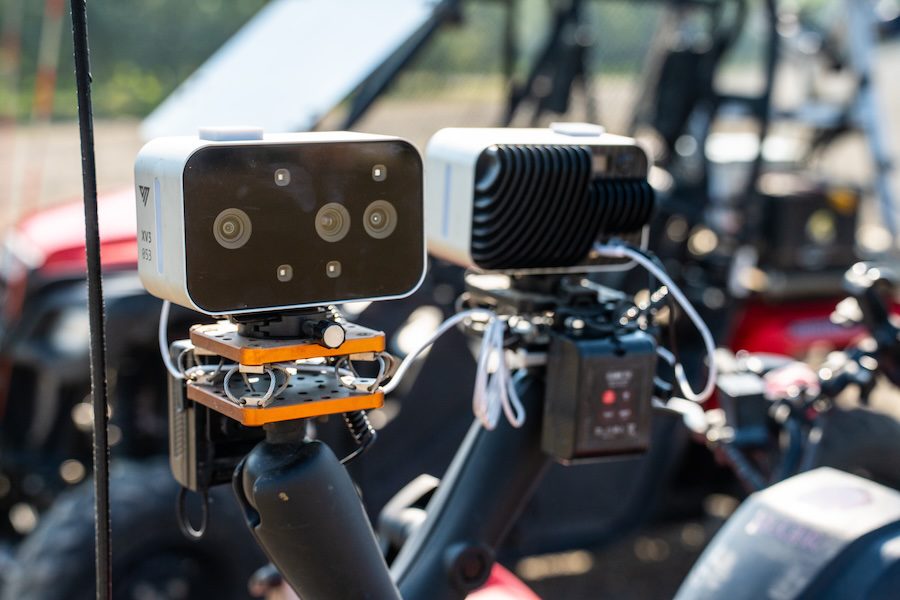
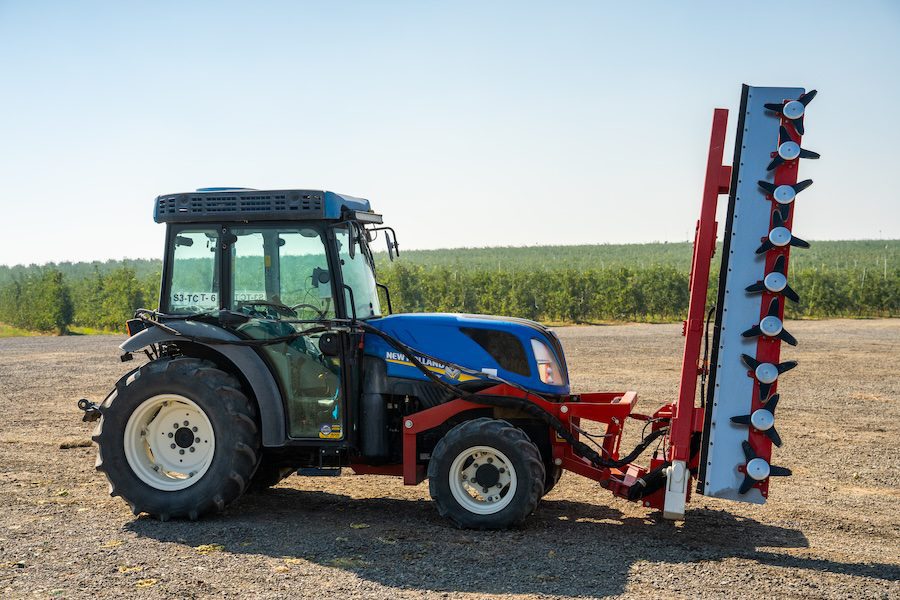
The orchard visions systems from Vivid Machines and Green Atlas (shown above), affixed first onto ATVs and soon to be bolted onto the autonomous tractors so the sensor-based systems capture data as the Bobcat tractors move about the orchard regularly, capture real-time tree scans that are then downloaded and mapped to inform Okanagan’s pruning and chemical thinning programs. The goal is to balance the pursuit of vegetative growth with fruiting potential for each tree. Too much fruit on a tree? That fruit will likely be small and not as marketable. Or, if you have too little fruit spread across the canopy, the tree could eventually only produce fruits with excessive size, low fruit firmness and lower quality flavor, according to Carter.
“We use tools like Green Atlas and Vivid to know going into [thinning] how many fruit spurs we have and how much fruit we want to knock off? And then we write our millimeter spray [programs] to kind of correspond to that vision data,” said Carter. “In our case, we might have a much more aggressive millimeter spray on some block than others because we know there’s a lot of frost damage or this very light crop in this Gala block, because [the data shows] there’s only 40 fruit spurs in the tree.”
In that case, Carter explained, you would point to the data and decide to just do one pass with your millimeter sprays or use a half rate. But if he has a block where the data says there’s 240 fruit spurs per tree, then “I’m going to go in there and almost just try to knock the whole tree off.”
Carter says the farm also implemented used mobile heading and hedging platforms alongside tractor mounted hedgers for its pruning crews. The result? Hand thinning costs plummeted significantly from an average spend of $1,250 to $1,500 per acre in 2024 to $86 per acre in 2025. And pruning costs were slashed to $117 per acre by using the hedgers and platforms, which is significantly less than the cost for traditional pruning methods (ie ladders and loppers).
“One of the benefits of hedging is that those interior branches in your trees spur up because hedging doesn’t make a super clean cut. So, you get a bit of a hormone response,” he explained, adding that he thinks the farm probably cut too much off the tree tops in 2025, which in turn led them to battling excessive fruit size in some varieties like Granny Smith.
“Playing around with the timing of our hedging is something I really want to explore because I think also pushing that out to right after millimeter sprays, you’re going to get a bigger hormone response, you’re going to stress your trees more and that will also create more of those fruit spurs in the center of your trees,” said Carter. “I think that would be something to play around with. But I would say for the Goldens, the Galas, those varieties took the hedging so well that I’m not even sure if I need to do any pruning in the bottoms of my trees.”
Cutting edge irrigation tech
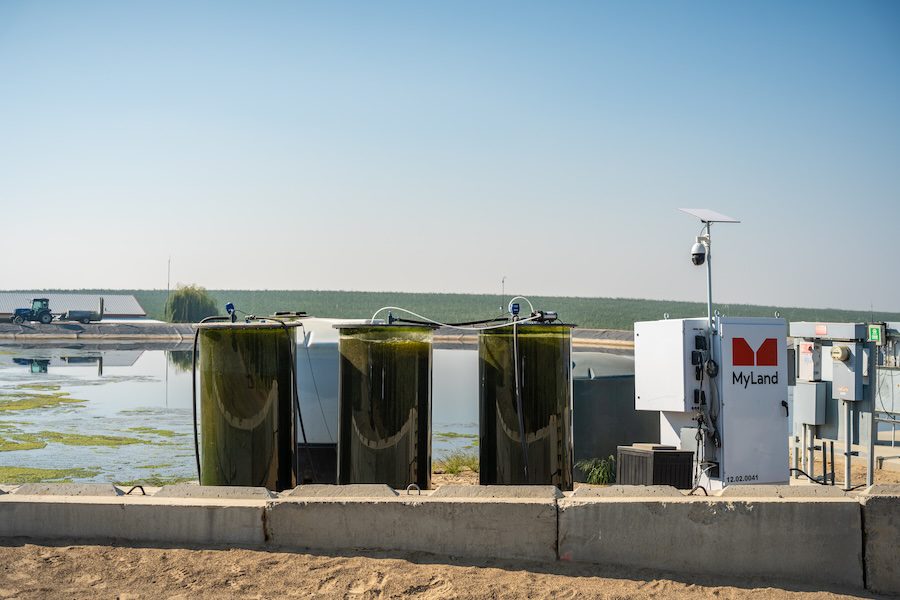
Carter also added two very interesting irrigation tech systems onto the farm.
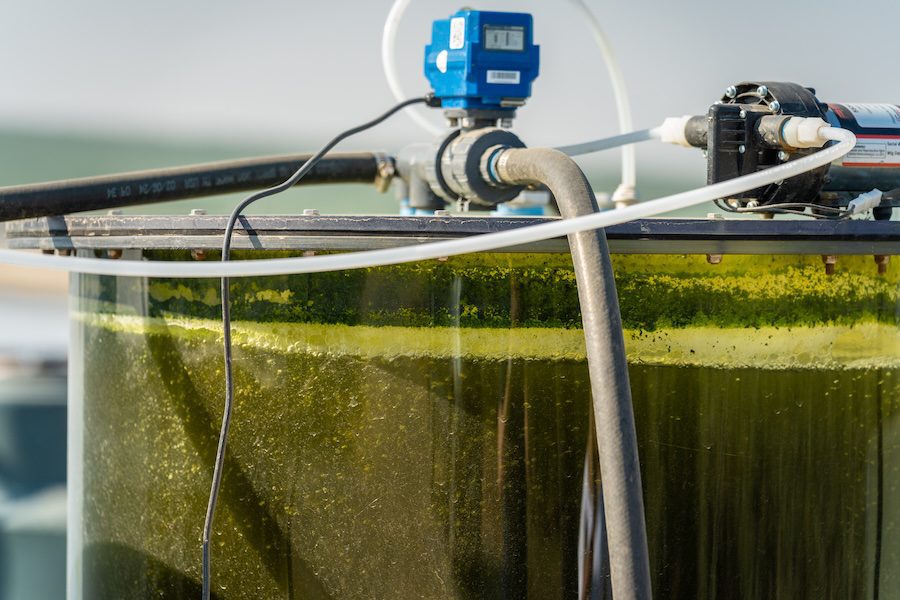
Moleaer’s nanobubble generator and MyLand’s beneficial algae injection tech (pictured above) are both in place as the project enters its second season at the orchard. Both systems require significant power loads that initially weren’t feasible in the blocks where the team wanted to try them out. That meant tacking on a small 12-panel solar array with a single 300 AH battery unit to store the harvested power until the systems pull it in.
Once the irrigation systems were powered up and running, Carter says the early results appeared positive, but the systems were also so new it was tough to know for sure what their true impact is.
“Being able to have that water penetrate your soils and the idea of getting more oxygen into the root zone is interesting to me,” said Carter, noting poor root respiration in the orchard’s trees prior to the integrations. “We also had a lot of bound up nutrients in our soils, so being able to free up some of those nutrients while also being able to get more oxygen into the root zone and more tree respiration, all that would be helpful. I’m optimistic it’s going to pencil out, but at this point I don’t have enough data yet.”
What Carter does know so far though is that the MyLand system does pencil out, because it costs about the same ($150 per acre) as two nitrogen applications or a “really good, blended fertilizer application.”
“The return-on-investment is there – it does justify itself, but it’s the upfront cost that just kind of hurts a little bit,” he said. “You have to put up a lot of money up front before you get anything back from it on the back end.”
Key takeaways
Looking back at year one of the ambitious orchard tech overhaul at Okanagan, Carter learned several things about taking ag tech from concept stage to real-world deployment:
- Worker crew buy-in and expertise: Carter says this is “crucial for success” and having a relatively young, tech-savvy team with strong troubleshooting skills and pride in workmanship is essential to making an ambitious undertaking like this a win.
- Equipment care: Expensive, sophisticated autonomous equipment and ag tech systems require top-notch in-house maintenance and operators with solid attention to detail to maximize uptime.
- Reliable vendor support: On-the-ground support from tech vendors (Carter specifically mentions the teams at Agtonomy, Innov8 Ag and Vivid Machines) is a critical component to keeping advanced tech running smoothly.
- Set realistic expectations: Having the organizational mindset that new technology, while useful, is not always going to be perfect helps everyone involved not grow frustrated when things inevitably breakdown or require troubleshooting.
- Connectivity matters: Central Washington’s poor rural internet connectivity is one variable that continues to frustrate and challenge Carter and his team. Many orchard tech providers are also seeing this issue coalesce, Carter says, and most are looking at integrating Starlink to help mitigate connectivity problems in rural production areas.
-by Matthew J. Grassi, managing editor