

Purdue: Iran conflict fuels fertilizer supply concerns






Four years after the start of the Russia-Ukraine war, which pushed fertilizer prices to historic highs, the current conflict in the Middle East has once again brought attention to the risks associated with dependence on imported fertilizers for domestic agricultural production, writes Joanna Colussi and Michael Langemeier with Purdue Extension.
With Iran restricting shipping through the Strait of Hormuz, a key route linking the Persian Gulf to global export markets, major supply disruptions have been affecting farms in the United States. This article looks at fertilizer supply and demand trends over the past five years, analyzing the scale of our fertilizer import dependence and potential implications for agricultural competitiveness.
U.S reliance on imported fertilizers
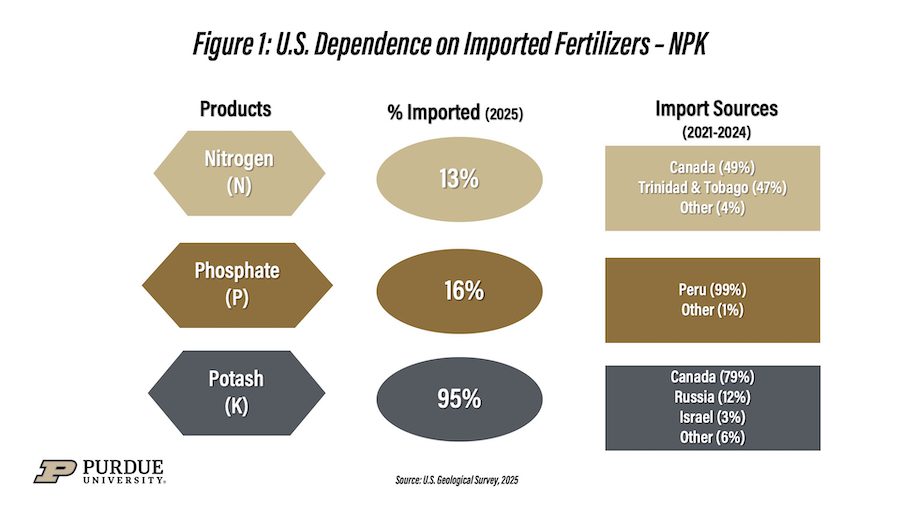
According to Purdue, the United States has a strong domestic fertilizer industry, supplying nearly 60% of its demand for the primary macronutrients: nitrogen (N), phosphorus (P), and potassium (K). Even so, it remains exposed to major supply disruptions and sharp increases in fertilizer prices.
In 2025, the U.S. imported 95% of its potash requirements, up from 93% in 2021, before the Russia-Ukraine war began (Colussi et al., 2022). From 2021 to 2024, Canada supplied 79% of the potash used in the United States, followed by Russia at 12% and Israel at 3% (see Figure 1).
U.S. dependence on nitrogen and phosphate imports is much lower (see graph above). Even so, this dependence has increased since 2021. Reliance on imported phosphate nearly doubled, rising from 9% in 2021 to 16% in 2025, while the share of imported nitrogen in total consumption increased slightly from 12% to 13% over the same period. Another shift over the last five years was the growing dependence on phosphate imports from Peru, which increased from 85% to 99%. There was also a rise in dependence on nitrogen imports from Canada, whose share increased from 30% in 2021 to 49% in 2025.
To read the full article from Colussi and Langemeier, head over to ag.purdue.edu