

Ridgefest: soil, water considerations spur orchard success
Michigan’s Ridgefest field day was recently held. Read about successful soil and water practices aid orchards.





Soil monitoring, crop rotations and consistent irrigation patterns are among key control points for managing a successful apple production system.
Nick Rasch of Rasch Family Orchards near Kent City, Michigan, outlined the operation’s approach in its Premier Honeycrisp, Gale Gala and peach orchards during July’s Ridgefest, sponsored by the Michigan Pomesters.
Rasch, who runs the apple and peach outlet along with brother Jake and father Don, said the use of Wilbur-Ellis’ Veris soil mapping system has enhanced the growers’ variable-rate spreading and soil sampling approaches.
Last fall, a Veris scanner’s soil examination offered a closer view, providing even more accurate variable rates spreading.
“It’s really helped,” Rasch said. “We’ve had some weaker spots on this farm that needed a lot of work.”
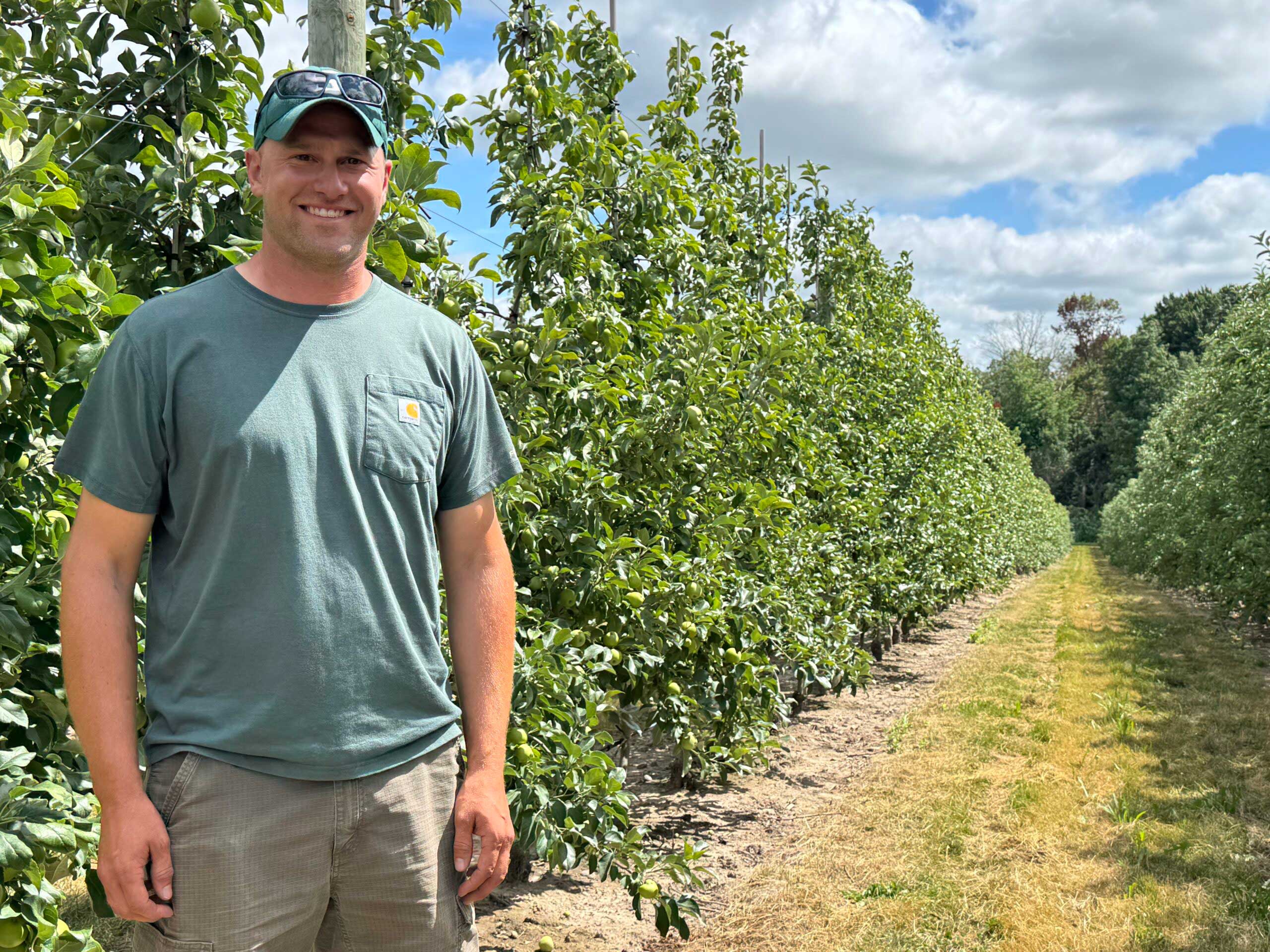
A Premier Honeycrisp block “has been one of our most challenging,” Rasch said. “It needed a lot of lime. It was an old Gala block that cropped real well for us for a number of years.”
Half of the block was replaced with soybeans for one year, the other half for two years.
“We could tell the growth of the trees was better after two years of soybeans before going back on a 40- or 50-year-old block,” he said.
The growers made that rotation approach a “standard practice.”
“We tear out an old orchard that’s been in the ground for 40 years and do two years of crop rotation before we put the orchard back in,” Rasch said. “That seems to really help.”
Parts of Michigan have suffered from near-drought conditions in 2025.
“Fortunately, we’ve got irrigation,” Rasch said. “This year we’ve seen it significantly improve the tree health on these smaller plantings. Especially on sandy soils, we’re seeing that even the irrigation is not keeping up.”
The Raschs normally irrigate Honeycrisp until the Fourth of July, “because if it’s dry we want to push calcium up into the tree with fertilizer and also return bloom.”
Irrigation on Honeycrisp is shut off before harvest, but Gala is irrigated up to harvest, if needed.
“We have a soil moisture probe on this farm. It’s been a real good insight on how we irrigate,” Rasch said.
MSU tree fruit educator Emily Lavely told Ridgefest attendees the researchers are using bee vacuums to determine what kind of pollen is on the bees.
“What pollinators are matching Honeycrisp chronology and when do those pollinators start working on those flowers in the orchards? We really are trying to understand what are the right pollinators for Honeycrisp, and what kind of bee activity should we be looking for,” Lavely said in describing the ongoing project.
— Gary Pullano is a Michigan-based journalist and former managing editor for Great American Media Services possessing more than 45 years of industry experience. Contact him at garypullano@gmail.com.