

Water quality management in orchards: Maintaining grove water
Water quality management is important for ensuring a successful crop. Read about research to improve orchard water quality.





“Optimum water quality for any crop can help improve efficiency, because crop production is maximized per unit of applied water,” he said.
Hardeep Singh, food systems advisor for UC Cooperative Extension, Central Sierra, said nitrates and salts present in the water are much of the concern to the growers and they monitor them by laboratory testing.
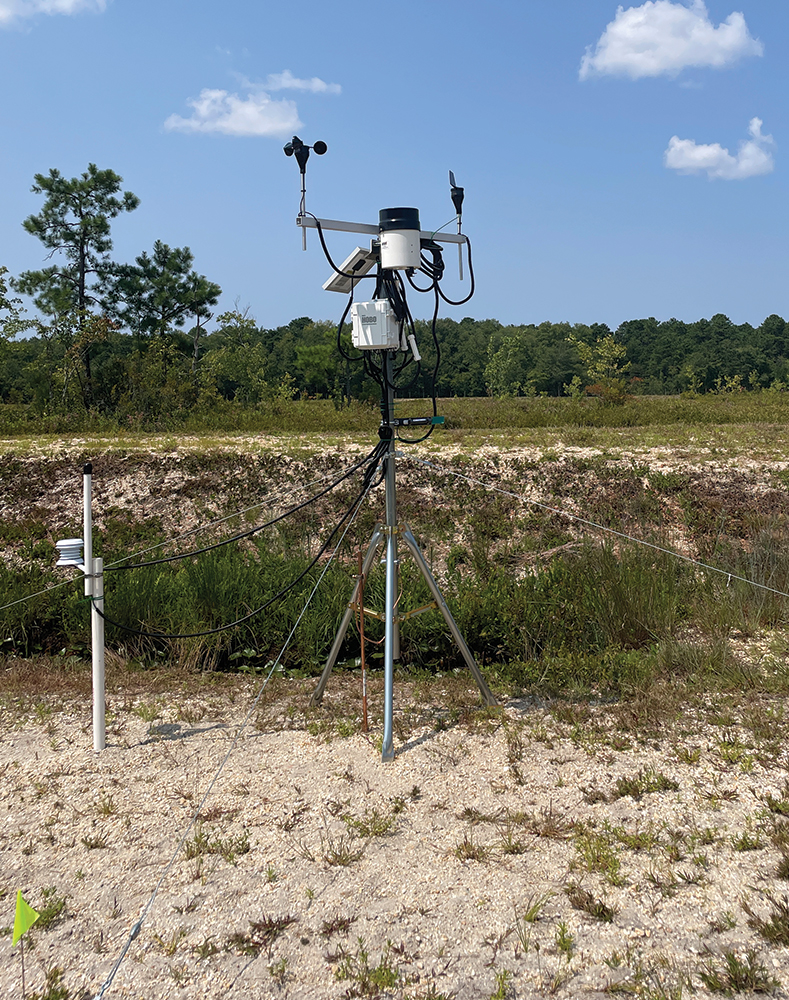
Weather stations play an integral role in monitoring conditions. Photo by Debbie Eisele.
That’s why farmers or their PCAs (pest control advisers) test the water samples for nitrates, salts, pH and other biological composition of the water. Most times, this is part of the annual package with the PCA/CCA (certified crop advisers) for all services.
“Growers use the data on nitrates for nitrogen budgeting and for application of control measures if there were any major contaminants in the water,” Singh said. “Water quality data may sometimes help with the leaching requirements.”
Emerging technologies
Farmers often collaborate with universities, agricultural Extension services and commodity organizations to stay updated on best practices and innovations in water management. Once a technology is available and affordable, there is generally widespread adoption. “With the help of on-farm demonstration research studies funded by USDA-NRCS, university researchers are collaborating with fruit and nut growers on water conservation practices,” Singh said. There have been many new technologies that fruit growers have been experimenting with on water management issues.“Nano-filtration and reverse osmosis are advanced filtration techniques that can remove salts and other contaminants from irrigation water, ensuring highquality water for orchards,” Wade said.
Variable Rate Irrigation (VRI) technology enables farmers to apply water precisely where it is needed in their orchards, reducing water wastage and ensuring that each part of the orchard receives the optimal amount of water.

Toro Tempus Ag moisture sensor courtesy of Brookdale Fruit Farm, Hollis, New Hampshire. Photo was taken at the UMass Orchard in Belchertown by Jon Clements.
“Smart irrigation controllers use data from weather stations and soil moisture sensors to automatically adjust irrigation schedules,” Wade said. “By optimizing irrigation times and amounts, systems like this help prevent over-irrigation and reduce runoff that can affect water quality in other areas.” It’s important that fruit growers integrate water quality data with other agronomic factors, such as soil health and nutrient management, to optimize overall orchard productivity.
“Precision application of fertilizers, often through fertigation (injecting fertilizers into the irrigation system), is a practice that helps make sure that nutrients are delivered efficiently to the plants directly through the irrigation system, reducing the risk of nutrient runoff,” Wade said.
Singh is keeping tabs on a grower who is using AQUA 4D, which he is testing at his orchard for water quality monitoring and management. “According to the company, AQUA 4D can remove bad minerals, reduce soil compaction, bacteria and nematodes in the soil when irrigated with AQUA 4D treated water,” he said.
Regulatory requirements The Regional Water Quality Control Board sets standards for nutrient management, including the amount of natural or synthetic fertilizers that can be applied to a field. That helps prevent overfertilization, which could leach to groundwater or runoff from a field into other lands or waterways. Singh added that growers are required to report the amount of nitrogen fertilizer applications to water coalitions such as Kings River in the valley.
 “They also need to report the amount of nitrogen in the irrigation water, and therefore growers have to get their water tested annually,” he said. “This is done by the growers themselves or their CCA.” Irrigation management Wade pointed to another part of the tree fruit industry that has been advancing water conservation practices. The industry has been improving crop water use efficiency for many years by investing in more precise irrigation management, he said.
“With 80% of almond growers using micro-irrigation, crop water use among almond growers has declined by 33% from the 1990s to the 2010s, and the industry has committed to another 25% reduction by 2025,” Wade said. “Improvements like that show that farmers care about the resources they use and strive to improve crop production and quality while saving water.”
Singh said that some growers use regulated/delayed irrigation, while others use ET-based irrigation scheduling as a guidance with other irrigation scheduling techniques. He also knows of some growers using subsurface drip in orchards that could result in water savings.
“Micro-irrigation, between drip and micro-sprinkler, we find 81% of growers use one of the two,” said Tom Devol, the board’s senior manager, field outreach and education. “Water scarcity has been an integral part of tree nut production for a long time and most tree nut growers are pretty aggressive about how they are managing water, and the type of irrigation is a big part of that.” Tree-based sensors, starting with pressure chambers, have been used for many years to monitor tree stress while weather monitoring — ET monitoring — is also heavily used in the almond industry. Almost 90% of growers considering the tech to help them understand what needs to be replaced, Devol said.
Soil moisture monitoring is the third important leg as it helps growers determine if they’ve effectively returned water into the ground.
Looking ahead, Singh believes that having more data and research on remote sensing and satellite imagery will help growers understand the issues and management