

Michigan researchers flag rising grape risks
Michigan experts warn growers about increasing grape disease and pest pressures. Read what researchers say growers should watch for next.





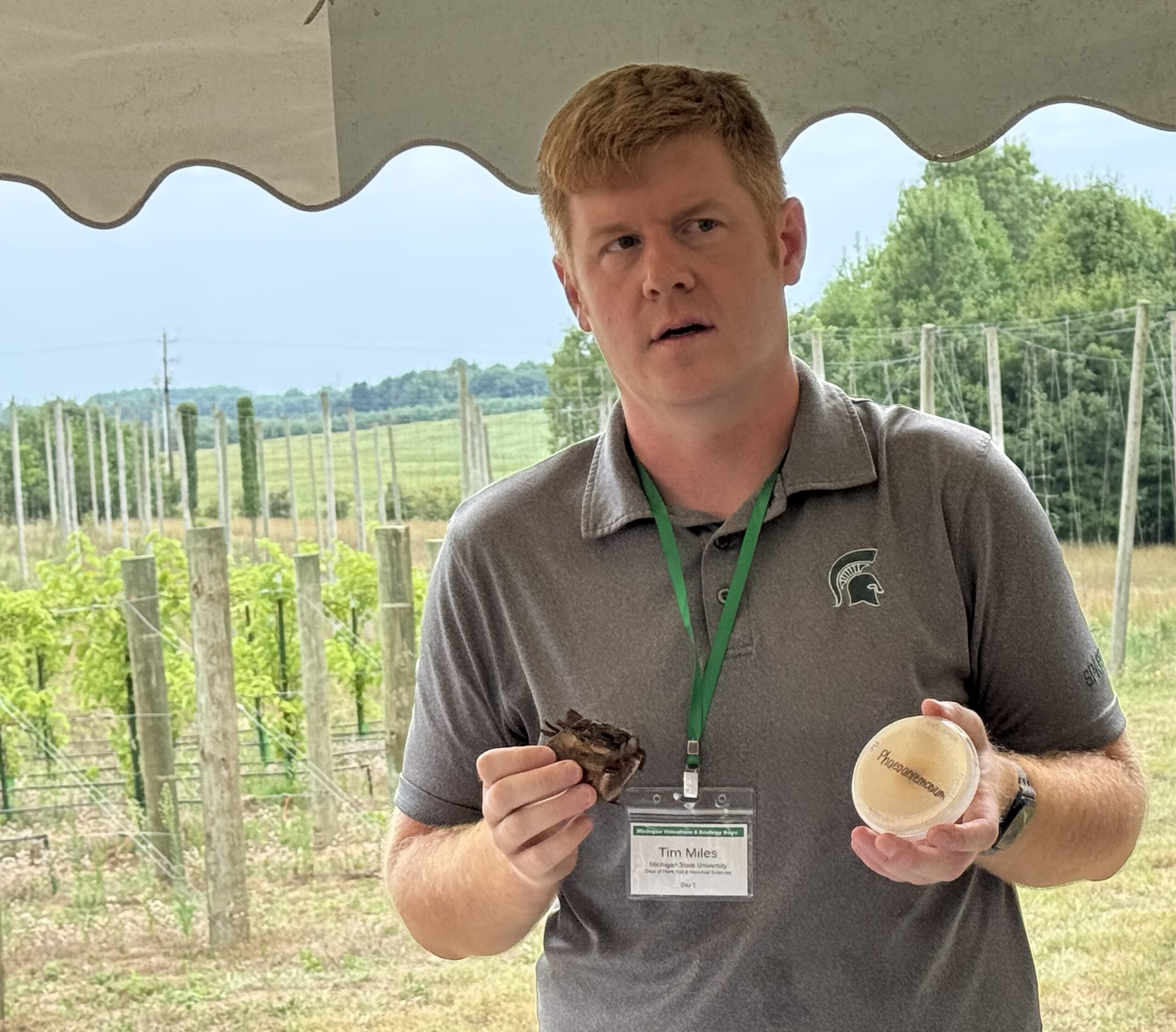
Tim Miles was tasked with discussing grape diseases that are difficult to control and assuring growers that these problems can be better understood through diagnostic testing services.
Miles, associate professor for the Small Fruit and Hop Pathology Laboratory at Michigan State University, placed grapevine trunk disease at the top of that list.
“The reason it’s a problem in Michigan is because we get a lot of freeze damage events,” Miles said. “There’s quite a bit of retraining that takes place right along the graft union. Over time, as our vineyards get older, we might see more of this trunk disease show up.”
Miles encourages growers to seek plant diagnostic testing and referenced MSU’s “Do you suspect grapevine trunk disease in your vineyard?” information sheet.
“MSU’s Plant & Pests Diagnostics can test grape viruses as cheaply as anyone in the U.S. at this point,” Miles said. “ It’s about $100 to do 17 viruses, which is cheaper than a diagnostic lab in California and relatively more affordable than others.”
Black rot threat
Black rot is a severe fungal disease that affects grape leaves, canes and fruit, turning infected berries into hard, black “mummies,” according to researchers at MSU.
“If you have visual black rot symptoms, the infections probably happened a month ago,” Miles said.
He also flagged a concern in the commercial grape industry regarding an EPA proposal issued in August 2024. Because of potential post-application worker health hazards, the agency is seeking to cancel the use of mancozeb, a multi-site fungicide commonly used to control Phomopsis, downy mildew and black rot in grapes.
“Everybody’s worried about the use of Manzate (mancozeb),” Miles said.
Pest challenges
Rufus Isaacs, an entomologist, MSU professor and Extension specialist, directs the Berry Crops Entomology program.
Berry moth is a persistent pest that gives growers many headaches and doesn’t take long to lay eggs, he said. Isaacs recommends protecting and closely monitoring sites experiencing berry moth pressure and applying second sprays when necessary.
Holding up a leaf with a small folded-over section, Isaacs said, “that’s what grape berry moth larva does before it pupates. It actually makes a little sleeping bag for itself. It pupates inside that, and the moth emerges from it.”
There are many registered chemical products for berry moths, but “people still struggle with controlling them,” he said. “There are some newer products over the last five to 10 years and more coming, like Delegate. And we have some growth regulators like Intrepid that have residual control.”
More help may be on the way
“I haven’t been excited about a new insecticide for a while, because the ones we’ve had the last couple of years have been OK but not great against berry moth,” Isaacs said. “There is a newer trial of a product that is not registered. A grower can’t use it yet, but we can test products before they get into commercial production.”
Isaacs’ lab is working with Syngenta to trial its isocycloseram formulation, a broad-spectrum contact insecticide with a new mode of action that targets an insect’s nervous system. The product contains plinazolin, which protects against grape berry moth damage in Niagara grapes, which have thin skins and tend to split.
Isaacs said the Syngenta product has shown positive results against grape berry moth.
Sour rot management
Sour rot is a disease complex caused by yeasts, bacteria and vinegar flies. The risk is greatest in thinskinned grape cultivars, especially when berries split from crowding after heavy rains and when conditions favor microbial and insect growth.
Minimizing berry injury, preventing insect feeding and reducing bird damage are important components of integrated sour rot management.
MSU trials at several grape-growing sites show that reducing cluster compactness through leaf pulling also lowers the risk of sour rot.
Researchers also noted that when weather favors rot development, treatments starting at 14 brix can reduce infection and yield loss.
“When you get to veraison, or 12-15 brix, it’s an important time to start protecting those rather than waiting until you see symptoms,” Isaacs said. “Another application can be made two weeks later. Some of the best treatments we’ve tested have sterilants in them, which cleans the cluster of pathogens that might otherwise attack, which can be very effective.”
Chemical applications to combat sour rot are most effective with a fungicide in conjunction with an insecticide.
Spotted lanternfly arrives
The invasive spotted lanternfly, known to be destructive to grapes, is now present in five counties in southeast Michigan, in the Toledo area and in northern Indiana, just south of Benton Harbor. The pest often resides in Tree of Heaven.
The Michigan Department of Rural Development’s website allows growers to report pest findings in their area.
While Michigan grape growers prepare for spotted lanternfly, researchers say they have a strong toolbox of registered products but still lack spray information because the pest has not yet been found in Michigan vineyards.
— Gary Pullano is a Michigan-based journalist and former managing editor for Great American Media Services possessing more than 45 years of industry experience.
Above photo: A row of grapes in a vineyard at the Southwest Michigan Research and Extension Center (SWMREC) in Benton Harbor, Michigan. Photo by Gary Pullano.