

Plant disease primer: diagnosing crown, root issues in strawberries





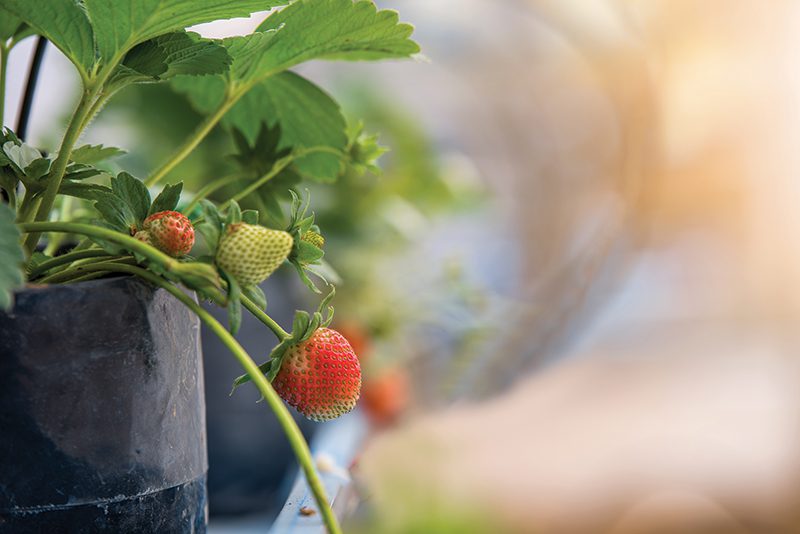
To make a diagnosis, plants must be dug up carefully to examine their crown and root system, keeping as much of the root system intact as possible. It is generally best to do this when you first suspect that there is a problem, and always before the plants are completely dead.
Healthy crowns and roots
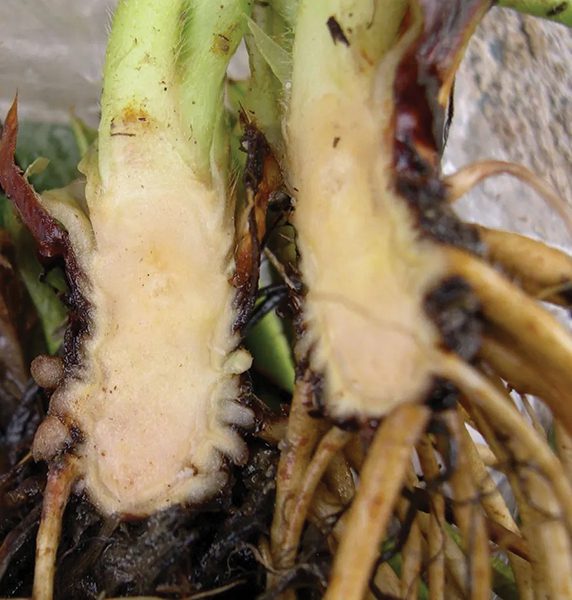
Young, healthy crowns and new primary roots will be white or cream-colored throughout when first cut and feel firm (shown left). Once the crown is cut open and exposed to air, it will quickly darken (like cut apples would), at first becoming more golden in tone and then reddish-brown.
It’s normal for the surface of older roots to darken as the roots age as a protective, waxy layer is formed. Eventually, however, these older primary and secondary roots will turn brown and die, as feeder roots normally only live for one or two years, and primary roots for two or three. This is seen on older roots on plants being carried over in the plasticulture planting, and on mother plants in matted-row plantings.
In matted row plantings at renovation — where the soil is thrown up around the crown — the root system is renewed as new roots grow out above the old ones.
In plasticulture, the plant is dependent solely on primary roots that are aging if the planting is being carried over. On plants that are several years old, eventually, the lower portions of the crown will also turn brown and die.
RELATED – 2026 FGN Pest & Disease Survey report
Signs of trouble
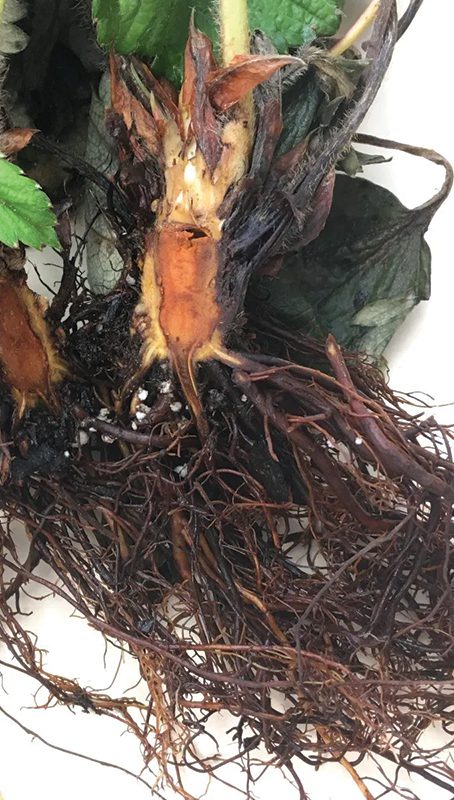
Crowns and roots on plants that are unhealthy will show a brown or reddish-brown discoloration. In many cases, it is possible to see that the tissue is being invaded with discoloration appearing to travel from the crown to the roots or vice versa (shown right). There will often be an acute change in color from healthy disease to infected tissue, or there may be a water-soaked appearance to the tissue.
Discoloration is often, but not always, asymmetrical. Sometimes, it is apparent that the invasion is taking place where soil is getting into the crown area, as in some cases of Phytophthora crown rot, or through a branch crown or root.
When the environment causes problems, as in the case of winter injury or high soluble salts in the soil, a connection to other plant parts where invasions are taking place usually isn’t apparent.
Crowns of dead plants are typically a dark reddish-brown, and completely dead roots turn black. Once entirely dead, there will be no difference in appearance whether the cause of death was a disease organism, severe winter injury, an herbicide application error, or severe drought and heat stress.
When attempting to diagnose problems, for the reasons mentioned above regarding root appearance as roots age, it is often helpful to find young roots and determine if discoloration can be seen on them rather than trying to diagnose the problem on older roots.
Diseases, insect feeding and winter injury can damage strawberry roots and crowns.
Common crown and root diseases
Red stele
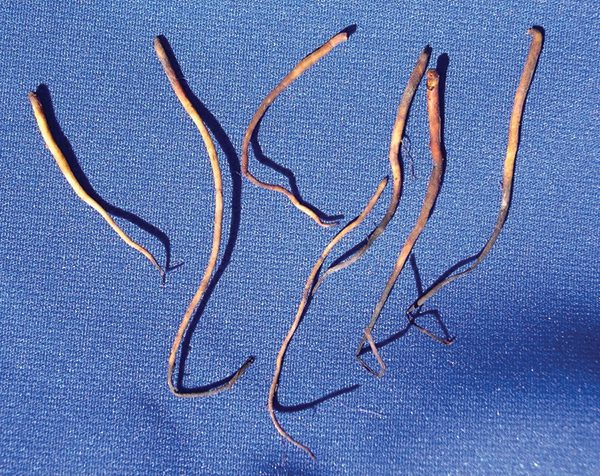
Red stele (Phytophthora fragariae) is caused by a soil-borne phytophthora species and is more common in low spots and wet areas. As indicated by its name, when roots are cut lengthwise, the core (stele) of the root is red. “Rat-tail” roots are a diagnostic characteristic of Red stele (shown left). As the disease progresses, fine lateral roots may be missing, and larger primary roots may be rotted from the tip back.
The Red stele fungus can persist as a dormant spore for many years in soil. In wet soil conditions, the fungus grows through the roots and produces spores, which can then swim to infect healthy roots in the field. If the soil stays saturated, the disease process can repeat itself. Strawberry varieties are available with varying levels of resistance to Red stele. Ridomil and Aliette or Phostrol are products that can aid in managing Red stele.
Black root rot (BRR)
‘Black root rot is a disease complex, meaning that several organisms — including Rhizoctonia spp., Pythium spp., other fungi and the lesion nematode (Pratylenchus penetrans) — can be responsible for the disease.
BRR is more common in older plantings or replanted fields. Also, fields that are already experiencing stress from wet soils, drought conditions and poor fertility are more susceptible to BRR.
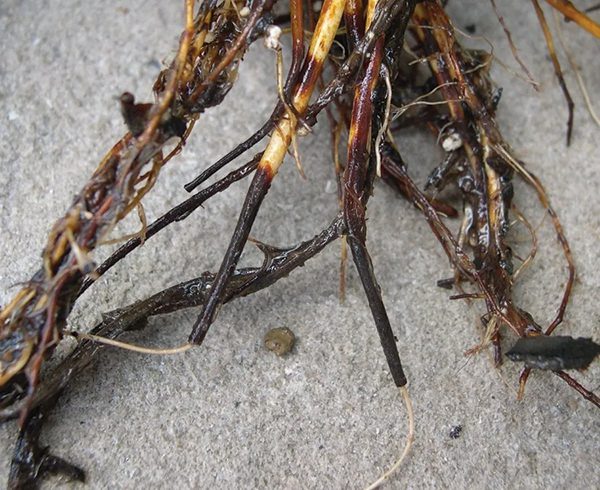
When examining the field, an uneven “patchy” appearance can be seen. Feeder roots decay, and primary roots blacken and deteriorate, allowing for the outer root surface to slough off and leave a white core (shown right). Dark brown lesions may be observed on healthy roots as they begin to decline.
BRR can be managed by rotating a field out of strawberries for four to five years, using raised beds and planting in well-drained soils with high organic matter content. No fungicides are currently recommended for control, but some growers have found success using beneficial bacteria dips prior to transplanting.
Phytophthora crown and root rot
Phytophthora crown and root rot (Phytophthora cactorum) is caused by a different fungal species than red stele. It is becoming more common, perhaps due to varietal susceptibility.
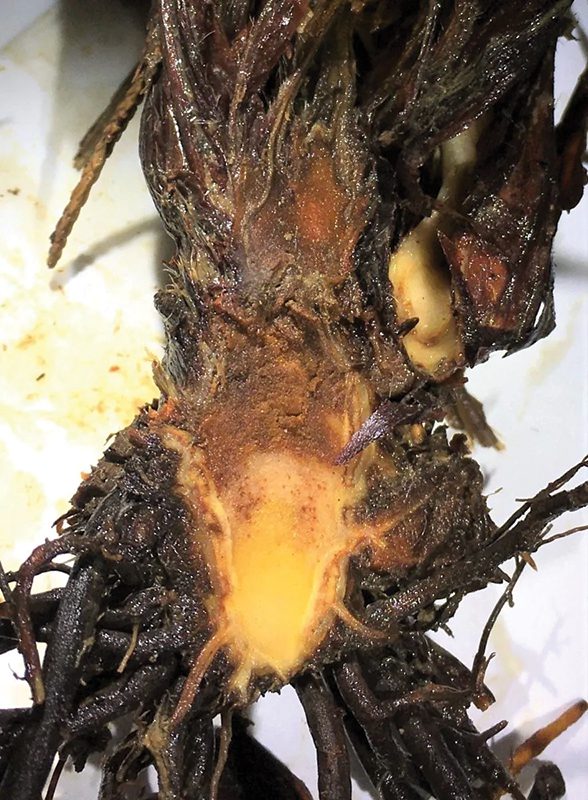
Symptoms first appear as stunting or wilting of plants. Eventually, the plant will collapse, and the crown will appear red- or cinnamon colored when cut (shown left). Plants infected with Phytophthora crown rot may break off completely from the crown when pulled for sampling. The disease may begin in low-lying areas of the field or in a scattered pattern if the disease was brought in from nursery stock.
Management strategies for Phytophthora crown and root rot include avoiding planting varieties that are known to be susceptible, including ‘Flavorfest’ and ‘Sweet Charlie,’ in fields that were planted to strawberries in the past five years. Also, use a plant dip of fosetyl-A1 or a phosphite product at the time of planting.
Neopestalotiopsis
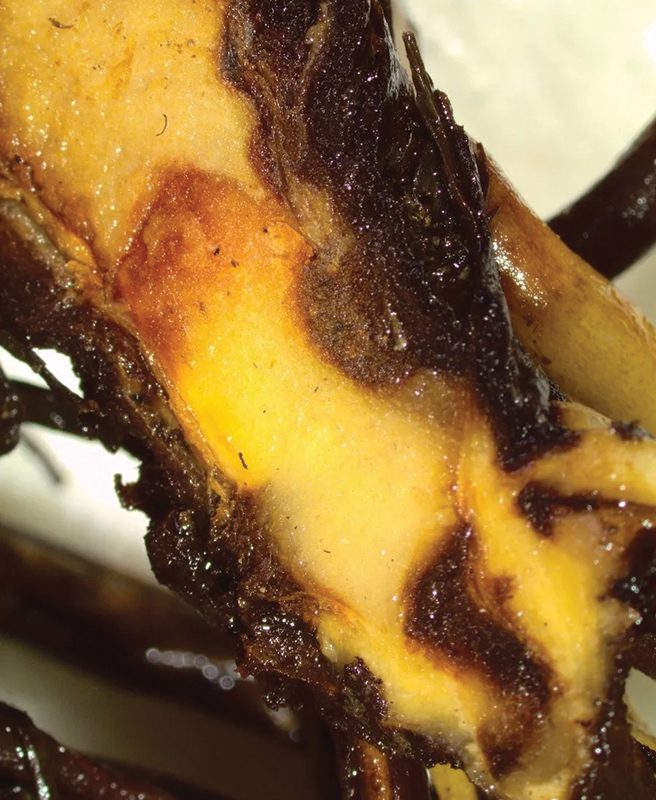
This is a new disease that can cause crown rot, leaf spot and fruit rot. The first symptoms are seen on the leaves and appear as tan to brown V-shaped lesions that are wider at the edge of the leaf or large tan spots. The disease can invade the crown and kill the plant, causing fruit rot symptoms like Anthracnose fruit rot. Crowns, when cut, appear more brown than red when infected with Neopestalotiopsis (shown right).
Outbreaks of Neopestalotiopsis have been associated with prolonged rainfall events, while disease pressure is low under dry weather conditions. Much of the research thus far has been done in Florida and shows that sprays of thiram and Switch seven to 10 days apart can reduce the disease by about 40%, with certain category 3 fungicides (Rhyme, Tilt, Inspire) also showing efficacy.
Anthracnose crown rot
Anthracnose crown rot (Colletotrichum gloeosporioides) is mainly a problem in rainy, warm seasons and especially troublesome in plasticulture production systems with susceptible varieties such as ‘Chandler.’
The first symptom of Anthracnose crown rot is that plug plants fail to grow following transplanting. However, symptoms are often not apparent until the plants collapse or die, usually in the fall or spring following transplanting during warm weather. When the crown is cut lengthwise, a reddish-brown color can be found. The primary source of infection is thought to be from infected nursery stock, though weeds and infected plant debris can harbor inoculum in fields.
Mulching with straw, even in plasticulture systems, can decrease the spread of the disease because it helps to reduce rain splash off the plastic. Fungicide recommendations are tricky because of resistance concerns, and growers should consult the most recent edition of the Mid-Atlantic Commercial Vegetable Production Recommendations for guidance.
Verticillium wilt
Verticillium wilt (Verticillium dahliae) is a fungus that can be found in many soils, especially those that previously grew tomatoes, potatoes, eggplant and peppers. Weeds such as pigweed, horsenettle and lambsquarters can also host the fungus.
Infection is a threat, especially when new plantings are established, and disease distribution may appear scattered in the field. The fungus infects the vascular tissue of plants and blocks water flow, causing plants to wilt and die. A distinguishing symptom of Verticillium wilt is that often the center-most leaves remain green and turgid while the outer leaves wilt and dry.
Planting verticillium-resistant strawberry varieties and using a three- to five-year rotation in fields avoiding all verticillium-susceptible crops is recommended.
Winter injury
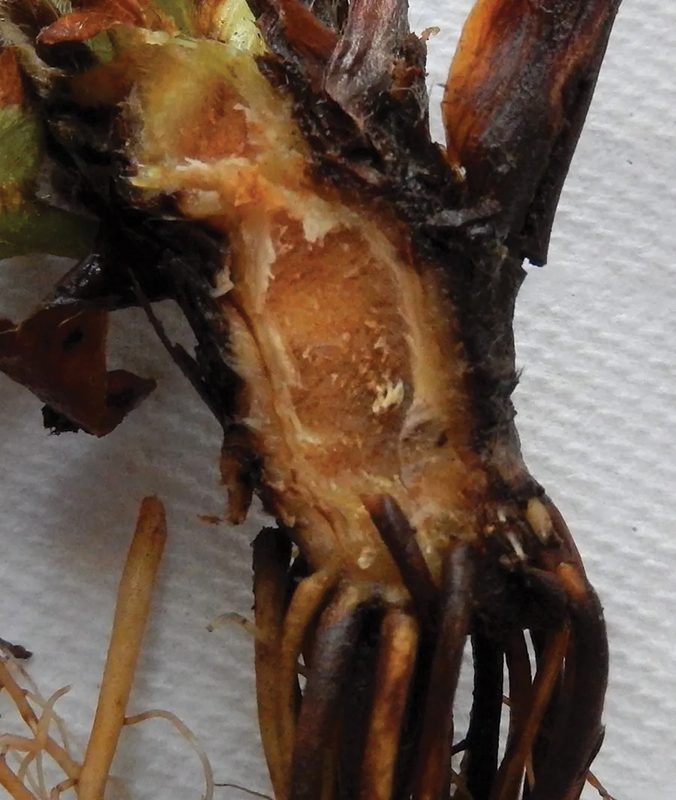
Winter injury is one of the factors that can result in the development of the black root rot complex. Symptoms are seen in late winter or early spring when the plants begin growing. Discoloration in the central crown area ranges from brown flecking to reddish brown discoloration (shown left). If over half of the crown tissue is affected, yields will be reduced, but plants may recover and yield nearly normally otherwise. To reduce winter injury, adequate and timely straw mulch or row cover application is important. Raised beds are more susceptible to winter injury, but often the benefits of raised beds outweigh the risk.
Key takeaways
It can be difficult to sort out reasons for plant decline. There can be multiple causes of crown and/ or root damage, and several may be present at once. Also, many display similar symptoms, which makes diagnosis challenging.
When diagnosing problems, look for other symptoms that may provide clues and check multiple plants. Dig plants carefully to preserve fine roots. Try to rule out causes based on field history, variety and timing of symptom appearance. For additional assistance, consult with your local Extension educator.
RELATED – Michigan researchers flag rising grape risks
(All photos shown courtesy of Kathy Demchak and Leah Fronk, Penn State University Extension)
Demchak is a senior Extension associate who works in research related to berry crops at Penn State University. Fronk is a Penn State commercial horticulture Extension educator based in Pennsylvania’s Juniata County.