
Jan 9, 2023Italian orchard all-in on multi-leader system
You know you are onto something when a group of apple growers from around the world stops in their tracks and oohs and aahs when they see your apple block for the first time.
Italian orchard manager Michele Gerin got just that when he hosted a visit by the International Fruit Tree Association Study Tour group in November.
Gerin is the farm manager for the Mazzoni Group, which grows more than 5,000 acres of fruits and vegetables in the northern Italy Province of Ferrara. The group is fully integrated and grows conventional and organic produce and sells it fresh and also processes the crops into frozen products.
The operation’s goals are to find the best system to improve fruit quality, reduce labor and increase yields for its apple plantings, Gerin said.
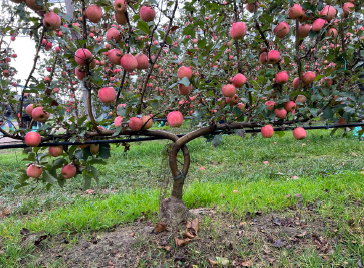
The slender spindle system was abandoned in 2017 and since then all apples have been exclusively planted on a multi-leader system, Gerin said. The operation grows 500 acres, half of them Pink Lady apples.
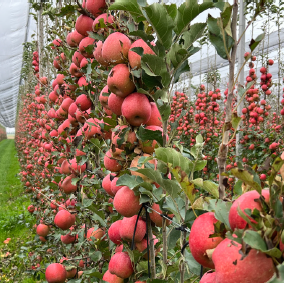
“The goal is for each tree to get more light for more color because we don’t have enough cool temperatures here,” he said. “We want a thin canopy.”
The system includes a 15% shade cloth that also works as hail protection. The trees are held up with a six-wire system with drip tape on the first wire. You won’t find any wooden posts here, as the entire system is supported by cement posts.
Gerin uses M.9 rootstock because the vigor is just right for the soil and fertility of the area. They have used three different spacings between rows including 11 feet, 10 feet and 9 feet. Space between the trees is four feet. They are using a bit stronger rootstock compared to slender spindle because they have found that the high amount of trees in the row reduced vigor.
Color is always a challenge in the area due to warm weather and the lack of cool

nights, Gerin said. With Pink Lady the multi-leader system colors eight days later than on slender spindle.
“We think it is because the engine of the tree is smaller and it takes more time to give color to the fruit,” he said.
The operation also uses a defoliator machine to blow leaves off the tree 20 days before harvest – or about the first week of October in that area. The fruit struggles to color up if the trees are defoliated too early, Gerin said.
The farm has its own nursery to grow the two-leader trees which cost them about $15 each to grow, double the cost of growing out a single-leader tree.
This system is very expensive on the front end, but pays off handsomely in later years, Gerin said.
“In the first three years we have 700 more labor hours per hectare training and affixing all the leaders to the wire compared to the spindle,” he said. “But once done, pruning and harvesting is much more simple and costs less than the slender spindle.
Mechanical pruning is used on the system in June which saves on labor. They have also found that the system produces 90% premium fruit compared to 65% on the slender spindle.
“We are also looking to reduce volumes and rates of our spray because there is no inside of the canopy to reach. We believe we may be able to use it without a blower,” Gerin said.
The operation is still learning as it goes but after five years Gerin knows he has found the winning system for the future.
— Matt McCallum, publisher/CEO
Top photo: This multi-leader tree system has paid off handsomely for the Mazzoni Group. Photos: Matt McCallum
Middle photo: The multi-leader system produces a wall of fruit that has a thin canopy allowing better light penetration to color the fruit.
Bottom photo: Shade cloth is required on all Mazzino Group apple plantings due to the high heat. It also serves as hail protection.




Current Issue

On-farm AI: Water, farm, labor research guide decisions
Data collection tool expands farm management
Carmel Valley winegrapes: Parsonage Village Vineyard
IFTA Yakima Valley tour provides orchard insights
IFTA recognizes tree fruit honorees
Pennsylvania recognizes fruit industry professionals
Fresh Views 40 Under 40
see all current issue »