







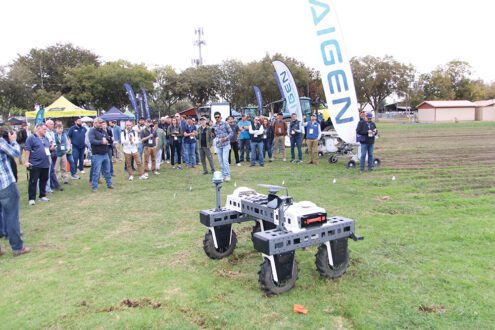
Jan 20, 2026FIRA USA: Robots redefine specialty crop farming
The future of specialty agriculture is increasingly automated and driverless. As equipment manufacturers and tech startups are developing more autonomous field robots and machines than ever before, these driverless bots are making the leap from concept to real-world tool,all in a quest to help growers save money on labor.
We were given a unique glimpse at this evolving, fast-moving section of AgTech during the International Forum of Agricultural Robotics (FIRA) USA show. The event brought together growers, ag technology providers and industry leaders for hands-on demos of autonomous machines capable of operating in orchards, vineyards and open fields.
The event is of particular interest to specialty crop producers searching for tech and machinery solutions to persistent labor shortages, rising input costs and profit margin pressure across high-value crops.
“These demonstrations are a good representation of what you can have on the market,” said Ben Palone, demo host and Western Growers’ senior director of automation and commercialization. “You will have implementation of robotic solutions that can actually go beyond a tractor.”
Automation momentum builds
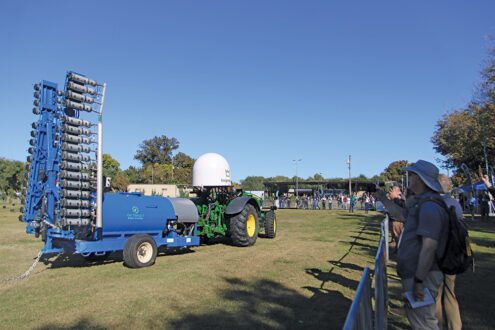
As autonomous platforms mature, many observers note a shift toward more capable, faster and increasingly specialized machines, particularly in smart spraying application equipment.
Smart spraying machines leveragecameras, sensors and edgecomputing alongside machinelearning and artificial intelligence todetermine crop from weed or pestin real-time, making applicationsto only the areas of the orchard orvineyard that require intervention.
“Coming to this event for a few years now, the chemical side is definitely growing,” said Josh Roberts, vice president of global ag development at Taylor Farms in Salinas, California. “There’s a lot more opportunities there, and that technology is constantly evolving.”
Smart spraying in orchards
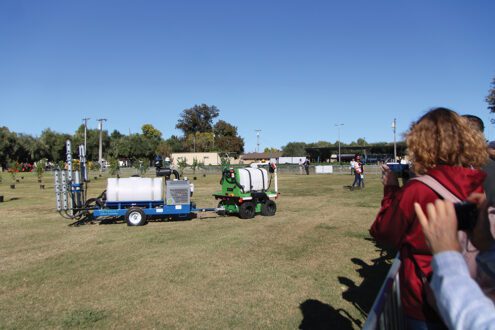
One of the most prominent smart spraying solutions on the market is the GUSS semi-autonomous ground sprayer from Guss Automation, a startup John Deere acquired in August 2025. GUSS is credited as the pioneer of autonomous orchard sprayers for almonds, pistachios, walnuts, pecans, stone fruit and vineyards.
GUSS machines self-drive through orchards, air-blasting crop protection sprays while being monitored remotely.
“Our idea was to find better ways of spraying,” said Gary Thompson, GUSS co-founder and chief operating officer. “That meant creating machinery that can self-drive through orchards and be monitored by a farm employee from the comfort of a pickup truck.”
Operators track performance through an app that displays detailed
data, even drilling down to the exact ounces of spray mixture applied to individual trees. The machine’s sensors also automate tree counts, canopy density and dimension metrics. Future iterations may incorporate disease recognition.
Smart spraying in fields
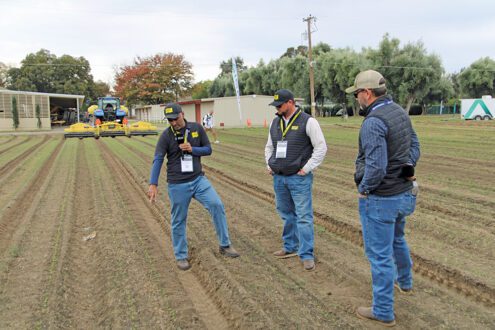
Swiss manufacturer Ecorobotix offers ARA, its AI-powered, ultra-high precision hooded spraying system for high-value vegetable and specialty crops. The smart, pull- behind system targets individual plants and aims to reduce plant protection products and fertilizers by up to 95%.
“Through data collection, we’re able to thin, precision weed and spray on-target — just the crop itself — with insecticides and fungicides,” said Kalen Cole, Southwest pre-sales regional manager.
Verdant Robotics, based in Hayward, California, has its Sharpshooter precision application system available to growers in the smart sprayer category. It’s another hooded pull-behind design capable of weeding, thinning and targeted crop protection application in-crop across a wide variety of specialty crops.
“Where the ROI comes from depends on the system that you’re in,” said Chad Yagow, director of digital agronomy, Verdant Robotics. “Out here in the West, it’s labor replacement. We’re usually seeing a six- to 18-month ROI.”
Mobility platforms for multiple tasks
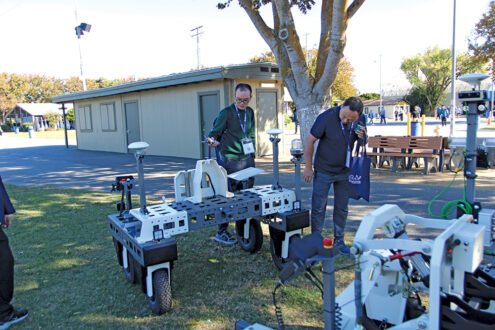
Mobility and versatility platforms are another sub- section of robotics finding a home on specialty crop operations across the globe.
Burro, based in Philadelphia, has an award-winning autonomous platform capable of performing tasks such as mowing, spraying and harvested material transport in vineyards, blueberry plantings and nurseries.
Burro’s remote control allows operators to advance the platform as trailers are loaded and unloaded, then move seamlessly into the field. The small, lightweight carrier bots can also be autonomously tasked via the companies’ BOSS (Burro Operating System) software.
Bonsai Robotics, a San Jose-based developer of vision-based autonomy software, launched its Amiga Flex carrier robot at the FIRA USA show. The autonomous, modular utility vehicle can navigate dense orchard and vineyard canopies despite dust, debris and occluded branches. Each Amiga Flex serves dual roles, operating as a shuttle robot during harvest and then transforming into an autonomous crop scouting platform for the rest of the year.
“Historically, the implement is used for 45 days of the year,” said Tyler Niday, CEO, Bonsai Robotics. “Instead of parking it after harvest, it becomes an autonomous machine.”
Heavy lifting takes flight
Autonomous drones also continue to draw greater attention from growers.
Temecula-based AgBee publicly demonstrated its Black Betty Stacked autonomous drone for the first time in 2025. Featuring anti-sway technology, the drone can spray crops and also lift up to 396 pounds of cargo, giving the drone a dual-purpose that adds value.
Josh Robinson, president of Ceres Air, said larger drones actually simplify flight.
“The bigger the drone, the easier the flight, because they don’t move as fast,” he said. “The only thing you’re responsible for is filling up that 40-gallon tank and changing out the batteries.”
Drone use cases continue to expand.
“Every two to three months, someone is coming up with a new idea on how to use this technology,” Robinson said.
— Doug Ohlemeier, Contributing Writer
Latest News
Agritourism to organic: 5 takeaways from the 2026 Southeast Fruit and Vegetable Conference
AppleTracker: Holdings reach 147 million bushels as fresh stocks fall and processing supplies grow




Current Issue

FIRA USA 2025: Robots redefine specialty crop farming
Inside Pandol’s success: How a multigenerational California grower leads in table grapes
Spray drones: best practices for specialty crop use
Farm Market and Agritourism: Strategies to attract today’s farm market shoppers
Ag Labor Review: Taking the reins — a new era for agriculture
see all current issue »