







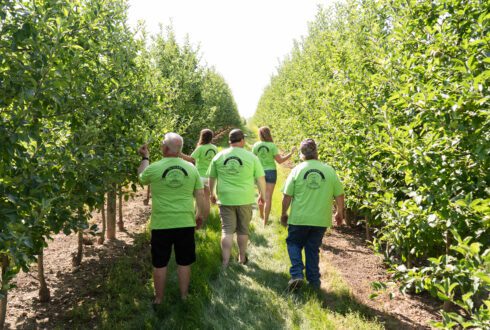
Jul 31, 2025Hollabaugh Bros.’ Pennsylvania tree fruit success
Diversification from tree fruit into other fruit and vegetable crops has helped Pennsylvania’s Hollabaugh Bros. Fruit Farm & Market complete seven decades of growing.
Twin brothers Donald and Harold Hollabaugh began farming in 1955, after spending their childhood s picking potatoes, tomatoes, cherries and other fruits on farms in southeast Pennsylvania. Both retired from the business in 2007, with Don passing away in 2016 followed by Harold in 2023.
While apples and peaches remain its core crops, Hollabaugh later diversified into pears, nectarines, apricots, plums, berries — including blueberries, raspberries and strawberries — and a variety of vegetables, all grown in Biglerville, just 15 minutes from Gettysburg National Military Park.
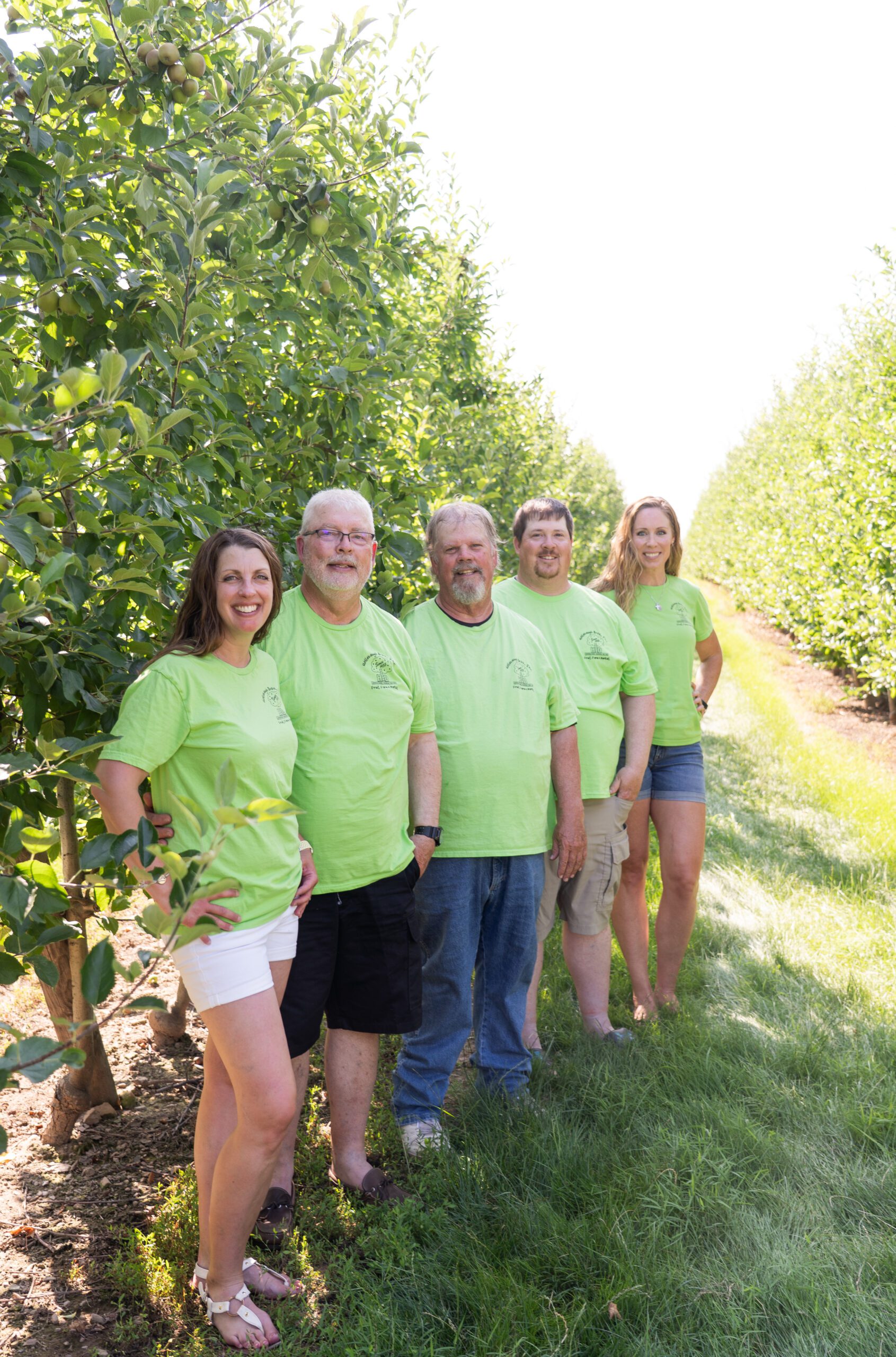
“Diversifying from tree fruits into small fruits and vegetables helped extend our growing season, offering a more dynamic mix of produce to our customers,” said Ellie Hollabaugh Vranich, business and retail market manager.
”It helped expand our income sources on the farm to support a growing family and offer a bit more depth in production to help buffer years when certain crops may have been affected by weather,” she said.
U-pick, agritourism success
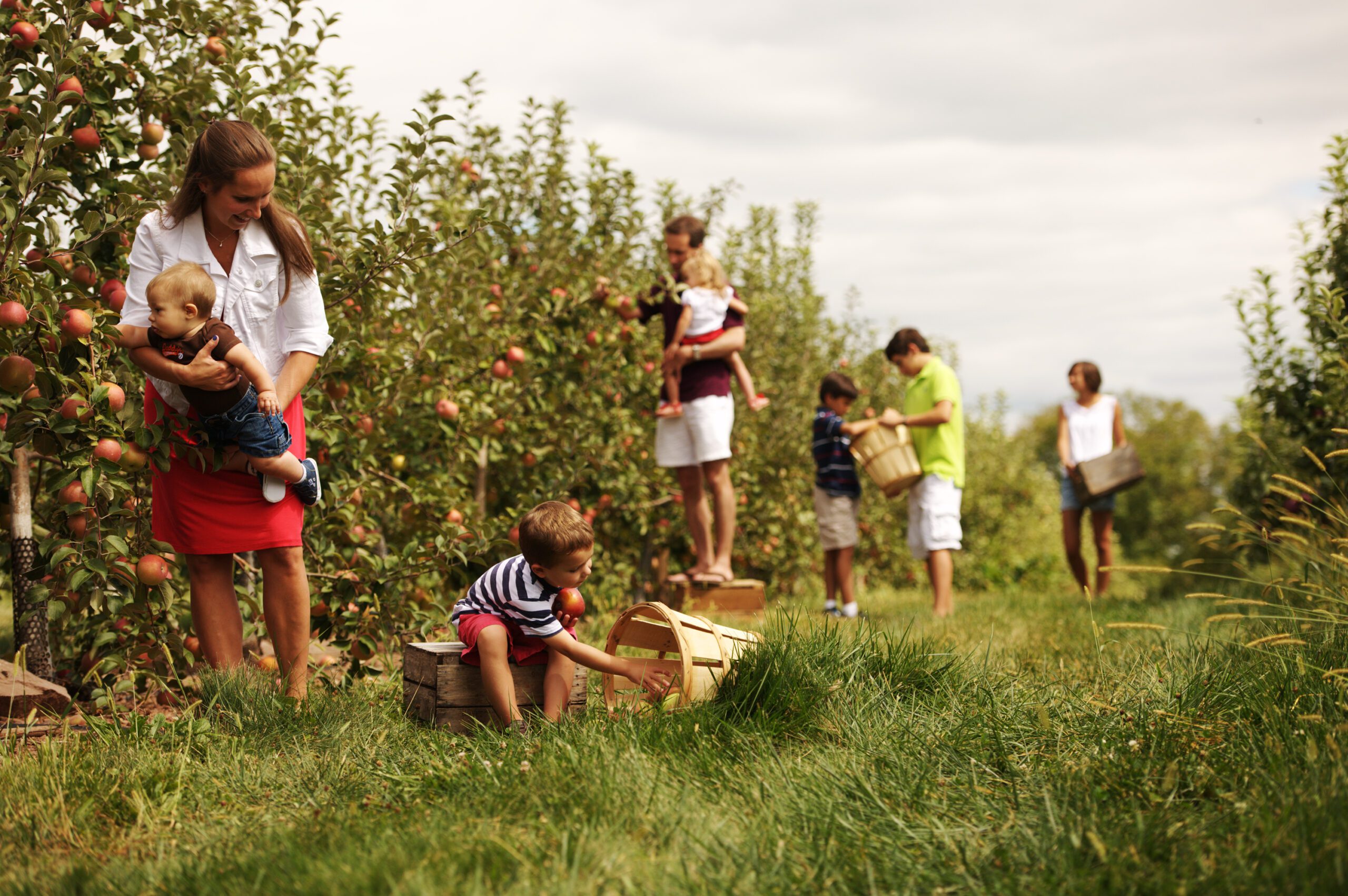
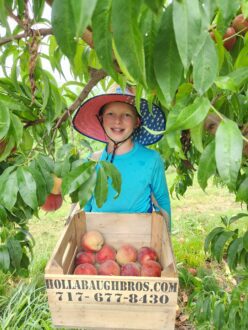
While Hollabaugh has offered u-pick apples for more than two decades, blueberries and cut-your-own flowers were more recently added.
“U-pick is a great additive offering that gives folks something hands-on to do when they visit the farm,” Hollabaugh Vranich said. “For us, it is a relatively small piece of our whole puzzle, but it serves its purpose. Remember that you’re pricing an experience, not a commodity.”
In 2012, a larger farm market replaced a retail market from the mid-1950s.
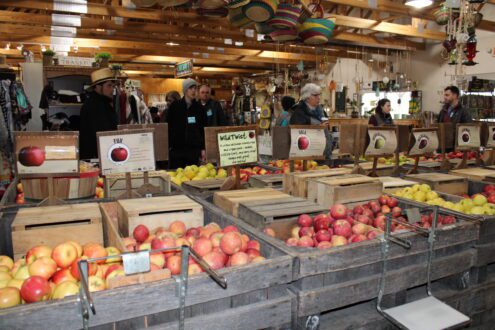
“Our retail market is the connection point between our community and our farm,” she said. “We are woven together deeply and mutually beneficial to each other. We feel it’s critical to play a role in helping consumers understand where their food comes from. COVID taught our society that food doesn’t just appear on a grocery store shelf.”

Hollabaugh hosts events like festivals, bunny trails and Mother’s Day activities, which help attract new customers and expose consumers to farm life to show them the challenges growers face, Hollabaugh Vranich said.
“We dabble very gently into the world of agritourism,” she said. “For us, it’s critical that we work very closely with our insurance company to ensure what we’re doing on the farm is covered. Sometimes, that means we can’t do things we want to do. But, in the litigious society in which we live, we’d rather have a farm than lose it to a lawsuit we can’t defend.”
Input, climate pressures
Inflation— combined with depressed apple pricing following heavy crops, lack of overseas markets and other factors — poses significant challenges to apple farms. Because of escalating yearly AEWR rates, labor costs continue to skyrocket.
While the region’s climate and soil types are optimal for tree fruit production, heat and humidity also invite disease. Pome fruit disease problems include apple scab, fruit rots and fire blight, while brown rot and bacterial spot harm stone fruit.
All Mid-Atlantic tree fruit growers must maintain consistent and thorough cover sprays beginning in the dormant period based on weather conditions, disease modeling and pest pressure, Hollabaugh Vranich said.
Major insect threats are brown marmorated stink bug (BMSB), spotted lanternfly and internal fruit feeders (IFF), including codling and oriental fruit moths, which require carefully timed control measures.
Mites, aphids and leaf hoppers can also damage both foliage and fruit on pome and stone fruits, while BMSB feed on fruit early in development, causing internal browning and pitting. Borers, including dogwood borer on pome fruit and lesser peach tree borer on stone fruit, can seriously damage or even kill fruit trees.
“Managing insect pests requires the use of weather data, establishing a biofix and using insect models carefully developed by our friends at Penn State University to properly time cover sprays with effective materials to prevent damage from and spread of insect populations,” she said. “Thorough, well-timed cover sprays must be used to allow a successful growing season.”
Pest control
Hollabaugh employs mating disruption as a passive form of insect control, while the highly aggressive predatory mite, Typhlodromus pyri,, has become a modern-day hero for insect pest control. Predatory wasps invade BMSB and other insect egg masses that help maintain control in the orchard environment, Hollabaugh Vranich said.
Pre- and post-emergent herbicides are applied in narrow bands under tree rows, but most growers use renovation practices before orchard establishment to manage difficult weeds, she said.
Rotating crops like corn, soybeans, sorghum, sudan grass and rapeseed enriches soil with organic matter, while no-till technology loosens root systems to foster favorable new orchard environments, Hollabaugh Vranich said.
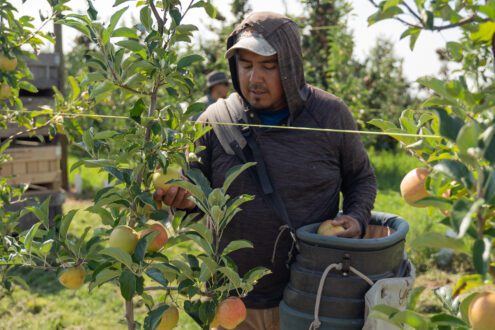
“By keeping a relatively clean tree row center, the use of herbicides can be reduced so rescue treatments are not necessary,” she said. “In all cases for disease, insect and weed management, it is critical to implement a strategic resistant management program that rotates chemistries of chemicals.”
Technology factors into all facets of Hollabaugh’s business, improving production, regulation efficiencies and decision-making. Automated irrigation technologies monitor orchard soil moisture levels, while digital controls and soil sensors regulate water delivery frequency and timing, Hollabaugh Vranich said.
High-density benefit
As growers transition to higher-density plantings, irrigation becomes a critical component of successful orchards. Drip irrigation systems efficiently conserve and manage water resources while delivering a consistent supply to growing trees, Hollabaugh Vranich said.
Installing drip irrigation, however, entails additional expense in orchard planning and may be cost-prohibitive, especially when water resources are not readily available. Historically, Mid-Atlantic region rainfall may be sufficient to sustain a new planting without irrigation, but it can be risky, especially for new plantings that begin their journey during a summer drought, she said.
While modern tree fruit management systems vary by grower, recent trends show fresh fruit growers planting higher-density orchards. Though expensive to install, these systems can increase yields and the percentage of high-quality fruit per acre, Hollabaugh Vranich said. Densities of 1,000 to 1,500 trees per acre are not uncommon in the eastern U.S., with four-wire trellis systems most typical.
Because stone fruit root stock selection is more limited, plantings are typically of lower densities of 150 to 200 trees per acre. Many growers still use open-center, pedestrian tree systems to produce quality fruit. Other systems, including the Parallel V or Quad V systems, have proven to increase per acre production but require careful canopy management and the use of ladders for harvest, she said.
High-density apple plantings provide the highest rate of return for the fresh market — if one can capitalize on orchard establishment. For processing apples, lower densities and smaller upfront investments are more practical, Hollabaugh Vranich said.
“New growers should have a clear, strategic plan in place for marketing their fruit before the first tree is planted,” she said. “The first step for any new grower is to know your market. Growing fruit with no plan is a good recipe for failure.”
Hollabaugh Bros. is run by second and third generation family members. In 2022, third-generation fruit grower Bruce Hollabaugh, 41, the son of Brad and Kay Hollabaugh and the husband of Amanda Hollabaugh, died. In 2023, Bruce was posthumously honored as Grower of the Year by the State Horticulture Association of Pennsylvania during the Mid-Atlantic Fruit and Vegetable Convention in Hershey, Pennsylvania. Bruce was recognized for improving and influencing Pennsylvania’s modern apple plantings through his inquisitive nature and drive to seek the best equipment, technology, management and root systems.
By Doug Ohlemeier, Assistant Editor
Latest News
U.S. Apple joins farm groups in letter to Congress detailing farm economic crisis as losses mount





Current Issue

FIRA USA 2025: Robots redefine specialty crop farming
Inside Pandol’s success: How a multigenerational California grower leads in table grapes
Spray drones: best practices for specialty crop use
Farm Market and Agritourism: Strategies to attract today’s farm market shoppers
Ag Labor Review: Taking the reins — a new era for agriculture
see all current issue »