

Jul 3, 2014Northwest pear estimate down from 2013 record
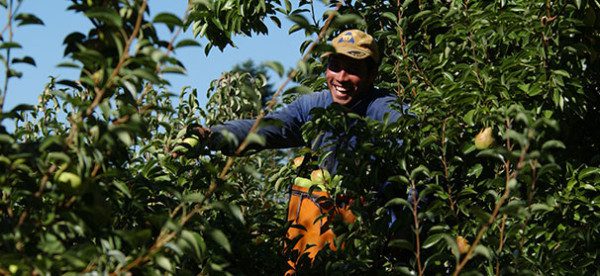
This year’s Northwest pear crop won’t be a record-breaker like last year’s, but growers were expecting quality fruit.
That was the assessment in early June, when Pear Bureau Northwest (PBN) projected a fresh-market crop of 18.7 million boxes (411,400 tons) for 2014. The estimate is 13 percent smaller than the 2013 crop (21.6 million boxes) and 6 percent smaller than the five-year average, according to PBN.
“While last year yielded the largest crop on record, this year’s crop is looking to be more in line with the five-year average,” said Kevin Moffitt, PBN’s president and CEO. “We haven’t had any major weather issues to date, and the industry is expecting a crop of excellent quality and fruit size to meet the demands of the domestic and export markets.”
Between them, Washington state and Oregon produce 84 percent of the U.S. fresh pear crop. PBN, which develops markets for Northwest pears, expected the 2014 harvest to begin in late July. Green Anjou pears are expected to make up 53 percent of the total crop, with Bartlett and Bosc expected to make up 23 percent and 14 percent, respectively. The bureau also projected 870,775 boxes (19,157 tons) of organic pears, 8 percent smaller than last year but 4 percent larger than the five-year average.
Exports
The top export markets for U.S. pears are Mexico, Canada, Russia, Brazil, Colombia, the United Arab Emirates, China and India – the last two being extremely strong growth markets, according to PBN.
Russia. Northwest pear shippers sent more than 500,000 boxes to Russia last year, a record. However, there are concerns that political tensions between the United States and Russia regarding Ukraine could affect the produce trade. The pear industry hadn’t been affected as of early June, but PBN was monitoring the situation, said Jeff Correa, PBN’s international marketing director.
Europe. Compared to last year, pear exports to Europe might be a bit smaller (and prices might be a bit higher), but that’s because of the smaller 2014 crop. About 70,000 boxes of Northwest pears were shipped to Europe last year. That’s down from about 350,000 boxes a decade ago, but exports to Europe have been in decline due to a maturing market and increased European pear production, Correa said.
Europe’s changing rules are complicating the export situation. In January, the European Commission lowered the permitted residue level of diphenylamine (DPA) on apples from 5 parts per million (ppm) to 0.1 ppm – an extremely low level, according to the New York Apple Association.
U.S. pear interests initially feared that the new DPA level would virtually eliminate all pear exports to Europe, but that fear was based on a misunderstanding of the impact DPA has on the pear industry. DPA is a plant growth regulator applied to apples postharvest, used to control scald. It is not used on pears, but there were concerns about cross-contamination in packinghouses that process apples and pears. Most pear packinghouses in Oregon and Washington deal with pears only, however, so it turns out very few Northwest pears (about 6 percent) might have DPA residues. Long story short, DPA won’t prevent U.S. pears from being shipped to Europe this year, Correa said.
Another concern is morpholine, an ingredient used in fruit wax coatings in the United States. Europe has no tolerance level for morpholine, so if they want to ship pears to that continent, U.S. shippers must find alternative waxes or not use wax at all, Correa said.
China. After nearly two decades of effort, China finally opened its borders to U.S. pears in January 2013. The first full shipping season started in August of that year. The Northwest sent more than 185,000 boxes of pears to China during the first full shipping season – about 60,000 boxes more than the initial goal. Another surprise was that roughly half the shipments were of green pears. They assumed most of the shipments would be red-skinned pears, Correa said.
Considering the smaller U.S. crop (and potentially higher prices) this year, shippers would be happy to send the same number of boxes to China in the coming season, he said.
PBN is planning a “USA Pear Road Show” for the start of the China season. The road show, an “interactive learning center and mobile billboard,” will visit Guangzhou, Shanghai and Beijing, according to the bureau.





Current Issue

On-farm AI: Water, farm, labor research guide decisions
Data collection tool expands farm management
Carmel Valley winegrapes: Parsonage Village Vineyard
IFTA Yakima Valley tour provides orchard insights
IFTA recognizes tree fruit honorees
Pennsylvania recognizes fruit industry professionals
Fresh Views 40 Under 40
see all current issue »