

Feb 2, 2021Arctic air with coldest temperatures in two years poses threat to Michigan fruit
A Michigan climatologist is warning fruit growers that the arctic outbreak coming Feb. 7-9 will likely bring the coldest temperatures to the region since January 2019.
Jeffrey A. Andresen, professor and state climatologist for the Michigan Department of Geography, Environment, and Spatial Sciences, Michigan State University said the outbreak may be associated with a stratospheric warming event a couple of weeks ago resulting in the split/movement of a piece of the polar vortex into eastern Canada. This will bring an extended period of abnormally cold temperatures, strong westerly winds, low wind chills and lake effect snowfall.
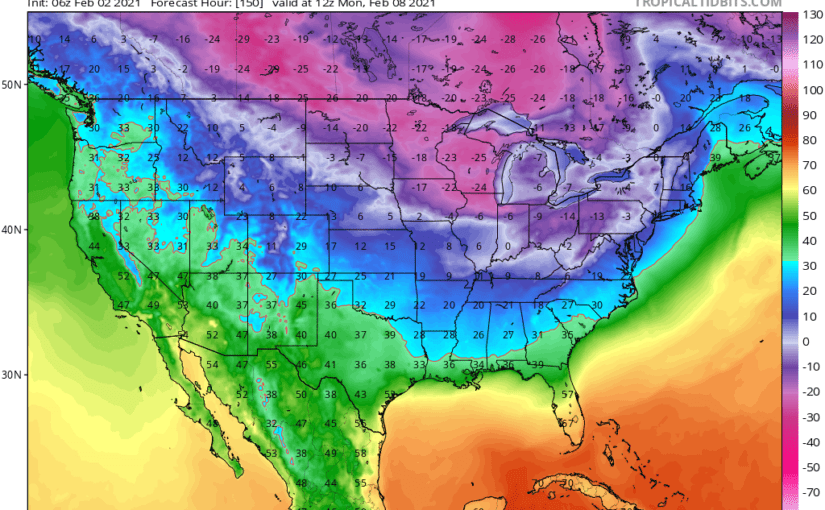
“The good news is that the lakes are warmer than normal with significantly less ice coverage due to the abnormally mild conditions thus far this winter,” Andresen said in a notice to growers. “So there will be significant lake effect cloudiness (and snowfall) downstream in Michigan vs. upstream locations which will help to moderate air temps.
“At this point, the guidance suggests minimum temperatures Monday and Tuesdaymorning in Michigan from the low single digits along the western lakeshore of lower Michigan to 5-10 below well inland.,” he said. “Without clouds and wind, the minimum temperatures inland would be significantly colder than this (10-20 deg or more).
“Finally, another reminder is that the forecast model guidance sometimes overplays the strength/intensity of features in the extended periods, so hopefully the actual event won’t be quite as extreme as it is portrayed currently,” Andresen said.
“Medium range forecast guidance suggests a general continuation of colder than normal weather through the end of FEB or even longer. So the recent upper air pattern and weather change will probably be with us a while. Hopefully not as extreme as what we might be dealing with early next week though. Overall, the forecast It is much more typical of La Nina conditions that what we observed during the first half of the winter.”
Anticipated impact on peaches
William Shane, senior Extension tree fruit specialist at Michigan State University’s Southwest Michigan Research and Extension Center (SWMREC), said in order to judge the implication of the forecasted temperatures in the low single digits for that area,”we have been using a controlled freezing chamber to test peach fruit bud hardiness for the SWMREC variety trial. Samples taken at the end of last week indicates that some varieties will start experiencing fruit bud death at temperatures approaching 7˚ F, but most require temperatures down to 1˚ to 5˚ F to start bud loss. Many had most or all buds were killed by -9˚ F. A few varieties had significant mortality by -2˚ F.
Approximately 20 buds were tested per variety taken from one to four trees, usually 2 two to three.
|
||||||||||||||||||||||||||||||||||||||||||||||||||||||||||||||||||||||||||||||||||||||||||||||||||||||||||||||
The research on peach bud hardiness was supported by a USDA Specialty Crop Block Grant, the Michigan Tree Fruit Agreement, the Michigan Peach Sponsors and Michigan State University.
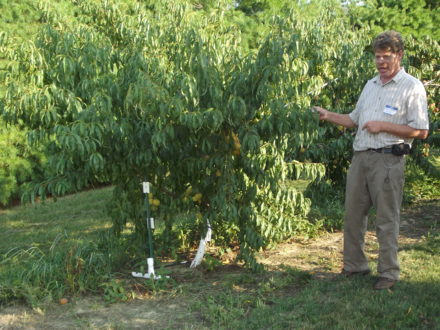
Photo at top: MSU’s Bill Shane in a peach orchard at the Southwest Michigan Research and Extension center. Photo: Gary Pullano





Current Issue

Advancing research in biocontrols
Inflation, farm input costs shape farm market prices
Farm market pricing guide
Great Bear Vineyards’ organic journey
Organic Grower: Field Watch
A win for farmers
Business: Improve the odds
Farm Market & Agritourism: markups vs. margins
see all current issue »