
Dec 3, 2012Robotic strawberry harvesters demoed in California
Agrobot, a company based in Huelva, Spain, recently demonstrated a robotic strawberry harvester at the University of California, Davis (UC Davis). The company is working to bring robotic technology to strawberry harvesting and hydroponic growing, with the goal of reducing labor costs, said company representative Miguel Ángel Vázquez Rodríguez.
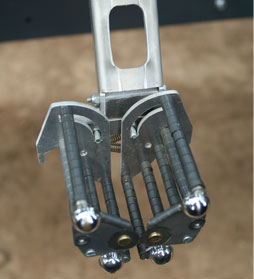
The company’s strawberry machine uses a rubber-lined basket to grasp fruit that’s identified by workers as harvestable, according to Mark Bolda, an Extension educator with UC Davis. The fruit is “picked” as it is lifted from the pedicel. A small, round razor on one side of the basket frees the fruit. The berry then moves on a conveyer belt to a worker seated at the front of the machine. The worker inspects the berry and places it in a container, such as a clamshell or other receptacle.
The company first started working with the California Strawberry Commission in 2009, with the aim of adapting its technology to the requirements of California growing systems, Rodriguez said.
Agrobot shipped its first strawberry harvester to California several months ago, to monitor its performance in California conditions – these include new varieties, bed shapes and plot designs. Entering the California market, the most valuable strawberry market in the world, is the company’s main goal, he said.
Agrobot also is looking at getting the technology into Japan, Australia and other European countries, where labor costs are substantially higher, Rodriguez said.
“We are first preparing several trial plots in different climates,” Rodriguez said. “Once we are sure that performance is appropriate, we will move forward with high-scale production to supply consumer demand.”
Currently, the machine is in use at only one producer in the United States, Central Coast Produce Inc. in Nipamo, Calif.
Bolda, who hosted the field day at UC Davis, wrote in a blog post that the machine was impressive, but not without potential problems.
“For one, the varieties currently in use produce many fruit in one cluster, which the machine has difficulty distinguishing from one another,” he said. “Secondly, the strawberry field must be radically reshaped to accommodate the machine, including farming strawberries in single rows – reducing plant count and subsequently lowering yield per acre. Growers also must raise the beds substantially. Third, the machine cannot think for itself and will not find fruit behind foliage or sequestered within the canopy of the plant.”
Rodriguez said the technology is applicable to harvesting other crops, such as trees fruit and some vegetables. In current tests, the machine is capable of harvesting just over a half-acre of fruit per hour.
The main advantage, he said, is the high level of savings that comes from robotic harvesting. Agrobot claims the technology can reduce labor costs by more than 50 percent.
“The Agrobot is a remarkable invention and worthy of a look and consideration by those who haven’t seen it yet,” Bolda said.
Rodriguez said Agrobot hopes to have machines available for sale soon, although no price has been determined yet. For more information, visit www.agrobot.com.
By Derrek Sigler, Assistant Editor





Current Issue

On-farm AI: Water, farm, labor research guide decisions
Data collection tool expands farm management
Carmel Valley winegrapes: Parsonage Village Vineyard
IFTA Yakima Valley tour provides orchard insights
IFTA recognizes tree fruit honorees
Pennsylvania recognizes fruit industry professionals
Fresh Views 40 Under 40
see all current issue »