






Nov 7, 2025Michigan Viticulture Field Day’s air, ground approaches aid vineyard management
Evolving technology is enticing vineyard growers and researchers who are targeting efficient techniques to drive down industry costs and increase profits.
Several of these concepts were showcased during the 36th annual Michigan Viticulture Field Day on July 30 at the Southwest Michigan Research and Extension Center (SWMREC) in Benton Harbor.
For nearly five years, Michigan State University viticulture specialist Michael Reinke has been working to improve the understanding of fruit crop system spray drones.
Most of the work on drone applications has occurred in field crops. Drones for fruit crop use must be set up differently, and pinpointing those differences has been Reinke’s focus. It took Reinke a couple of years to conduct full trials, including a season-long drone-only versus ground-only spray efficacy study, Reinke said.

All 10 of his 2024 trial sprays were split evenly between drones and ground applications.
“I really saw no difference in efficacy between the drone and the ground sprayer in the first year here at the station,” Reinke said. “Both of them did a really good job.”
In 2025, Reinke extended the project to a 5-acre plot of Concord grapes. Once again, he split the drone and ground spray applications evenly. He also added on-farm trials at three Michigan vineyards, including both juice and winegrapes.
Reinke’s goal is to work with growers who select the spray programs, while he tests whether drones can slot in and perform effectively in the growers’ programs. Some have wondered if juice or winegrapes make a difference in drone use but, so far, results look positive for both, he said.
Working with OnPoint Applications Group, Reinke has had access to two drones in 2025. He has previously used a P-100 XAG, and this year he added a P-150, which costs about $45,000. A small commercial support rig provides refill materials and rechargeable batteries, while Reinke uses a customized trailer for transport.
“It does take some setup, but they are still rather maneuverable and portable from a setup point of view,” Reinke said. “Both of them are doing a good job in the vineyard system. The P-150 is slightly better, just because it’s a newer one.”

The drones have been switched from hydraulic nozzle to rotary atomizer systems, which allow for flow rate adjustments and independent control of droplet sizing.
“It gives me a chance to spread the spray out a little bit better,” Reinke said. “At the bottom is a disc that spins independently of the flow of the liquid, so you can adjust flow rate and droplet size independently. The faster that disc spins, the smaller the droplets. You can change that and not change the nozzles to adjust your settings.”
Reinke has used a 3-D printer design to customize the factory atomizer discs to increase flow rates beyond the lower-rate field crop technology.
“We’re trying to learn whether we can change the discs for different needs,” he said. “Last year, I was limited to five gallons per acre in my application due to these factory discs. Now, with the custom discs, I’m doing 20 gallons per acre in a single pass, which is important with such applications as Intrepid insecticide.”
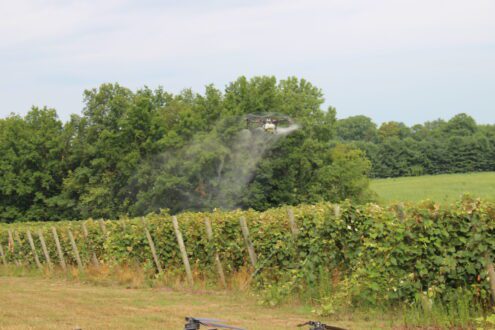
Standard ground sprayers produce drift. Intelligent or smart sprayers can reduce drift by 90%, with drones cutting drift by another 90% compared to smart sprayers, Reinke said. Drones produce virtually no drift compared to air-assist sprayers.
“People think you want to be right next to the canopy to keep the droplets going in and keep drift from happening,” Reinke said. “Because of how little drift I get, I’m not worried about that.”

Unlike helicopters or fixed-wing aircraft, drones do not create lift. They push air straight down.
“Think about it as if it’s an airblast sprayer turned on its head. You’re pushing the air straight down with air assist. You are controlling those droplets as they go into the canopy. You will see some swirling, but those droplets are still being controlled by that air. They will continue to drop behind that drone. “
Reinke flies the drone 12 to 14 feet in the air at 10 to 14 miles per hour. The spray swath is 15 to 16 feet.
“My goal is small droplets that are moving that canopy and get better penetration through the canopy, allowing for deeper coverage,” he said. “It took a couple of years of playing with these things from a fruit mentality to understand how to change those settings. You see a lot of people fail to change those settings when they try to do efficacy trials in fruit. They see failures, and they wonder why.”
Reinke is focused on consistent valuations and crop rankings to search for diseases such as berry moth, black rot and powdery mildew. He will also conduct disease evaluations at the end of the season for the on-farm trials.
About 80% of the spray products growers use are approved for aerial application.
Reinke displayed two other newer equipment technologies being trialed at SWMREC.
One is an intelligent spray-decision control unit developed by USDA researchers. The effort aims to develop a system that can be retrofitted onto existing sprayers. It uses standard RGB color system cameras to detect and assess plant characteristics and pest pressure in real time. The system automatically adjusts spray output to match the plant’s specific needs, improving efficiency and reducing off-spray targets. It can also capture photos for cropload estimation.
The second is a Spedo in-row cultivator and mower, which is being used for weed maintenance in vineyards. Purchased with funding support from the Michigan Tree Fruit Commission to do work in apples and peaches, the unit is adaptable to multiple implements and will help identify non-chemical strategies for vineyard weed management. It also will be used as part of organic and regenerative vineyard projects.
— Gary Pullano is a Michigan-based journalist and former managing editor for Great American Media Services possessing more than 45 years of industry experience. Contact him at garypullano@gmail.com.
Latest News
AppleTracker: Holdings reach 147 million bushels as fresh stocks fall and processing supplies grow






Current Issue

Michigan researchers flag rising grape risks
Blueberry legacy: Tawas Blueberry Farm remains a staple of its community
Organic Grower: Mechanical advances help target weeds in organic vegetable farm setting
Farm Market & Agritourism: Identifying underperforming products in your farm market
Ag Labor Review: Low-hanging fruit opportunities
see all current issue »