








Dec 15, 2025Accessing ag automation
The International Forum ofAgricultural Robotics (FIRA) conference brought growers from all over the West Coast to view the latest autonomous solutions for every stage of the crop cycle.
During sessions at FIRA USA 2025, held in Woodland, California, there was much talk about return on investment, grower access to capital and how growers can ensure they’re investing in practical equipment that saves them labor expense. At the event, AgTech purveyors heard how growers require access to capital to adopt tech, which benefits both the growers and the tech providers.
Tech providers told attendees how banks in the past have required growers to take loans out on their own credit and tell them the loan was for autonomous equipment before the bankers felt comfortable lending for tech purchases.
“One of the biggest barriers that we see is companies have this big push, especially when they’re VC-backed, to get that product to the market quickly,” said Nick Copass, division sales manager for the fabrication division of Yuma, Arizona’s Keithly-Williams Seeds. “They’re not willing to put in the time and the pain that’s required to listen. The European perspective is drive, drive, drive, push, push, push, a thousand demos a day. Go tell an American grower that you need him and [try to] force him to try to buy something. One of the biggest barriers that we’ve really run into is the manufacturer’s need for capital.”
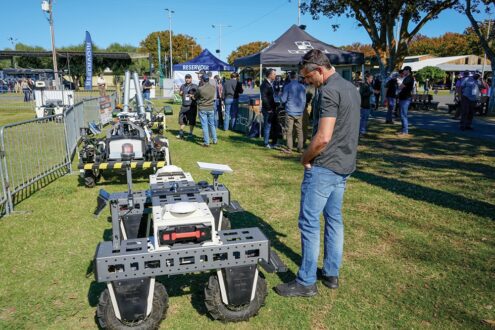
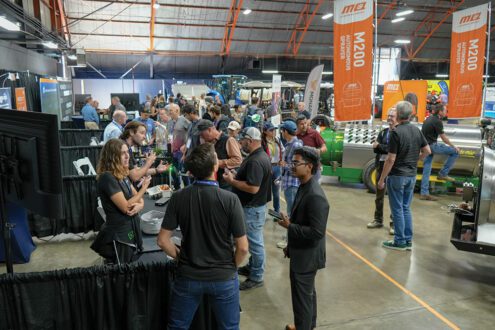
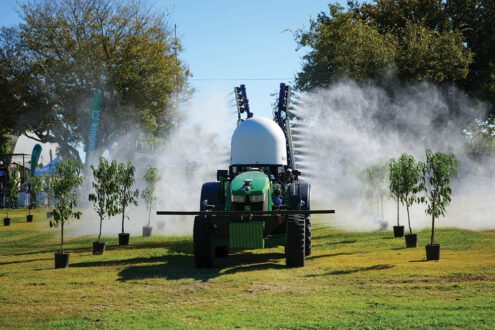

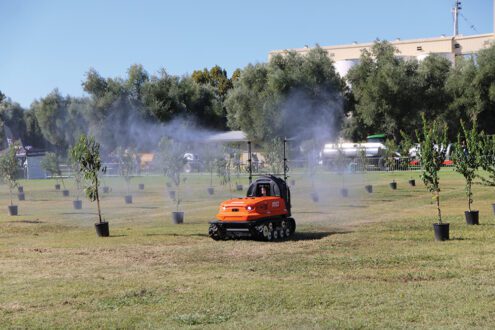

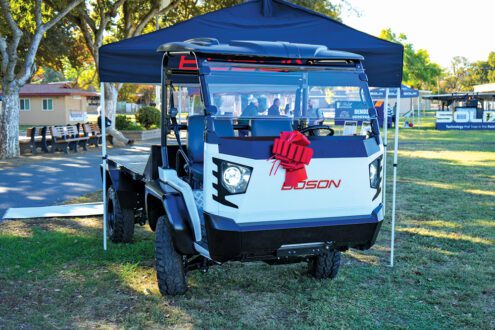
FIRA demonstrations included autonomous machinery, vehicles, which can do a number of tasks, including weeding, spraying and mowing. Photos courtesy Ben Sarion and Doug Ohlemeier.
Due diligence
Most startups will fail and many will end up being sold or go public, said Josh Roberts, vice president of global ag development at Taylor Farms in Salinas, California.
“You’ve got to really understand: Where are we going?” he said. “And that’s built on trust because they [the tech companies] can tell you whatever they want, but you’ve got to see through that and make a decision that’s going to keep you whole so that you don’t have it sit in the boneyard non-supported.”
Improved wi-fi access through Starlink’s satellite connectivity service is helping some growers implement technology, said Paul Mikesell, CEO of Carbon Robotics, a Seattle-based manufacturer of AI-powered robotics.
“It’s one of the big game-changers,” he said. “It’s also what allows us in our Auto Tractor to get around any of the exception cases when we’re doing big tillage jobs or doing laser weeding jobs and some crazy thing happens in the field where we need to remotely hop onto the autonomous tractor.
Data access to the field used to be a challenge, and now with Starlink it seems like it’s almost completely solved. It’s one of those things I would have never predicted when we started the company and how big of a difference that has made for us to be in agriculture.”
Tech fatigue
Growers must carefully consider the pros and cons of tech investments.
“There’s a fatigue around tech, and people are recently watching to make sure it works before they pull the trigger, but they’ve seen a lot of things that don’t work,” said AgTech pioneer Aymeric Barthes, FIRA-GOFAR chair and FIRA creator. Barthes is also the co-founder and former CEO of robotics startup Naïo Technologies. “They’ve been burned, so they’re going to be hesitant … they’re going to make sure it works.”
In sessions and field demos, AgTech providers told growers how they’re working to provide specialty crop growers tools that help them farm more efficiently through automation of many work tasks, including spraying.

Field challenges
“You might have certain scenarios where ground cover exists, maybe you’re trying to mow a cover crop, but it’s the beginning of the season, and the cover crop’s three feet tall,” said Nick Fisher, chief technology officer of Bay Area-based startup Agtonomy. The startup uses physical AI, the embodiment of machine learning, perception and cognition into a physical machine, to develop machines that help growers.
“You have fog. You might have water or low spots that the vehicle might get stuck in or muddy conditions,” he said. “If you can’t solve all these different types of scenarios from an autonomous perspective, then the value proposition of these vehicles doing automated work is really limited because someone’s always going to have to go help these systems out.”
Grower aid
In a session on navigating autonomy, Ben Alfi, CEO and co-founder of Bluewhite, an Israel robot and machinery manufacturer, discussed how robots are helping take care of grower needs in fields. Instead of operating one piece of machinery across 2,000 acres in a given day, an individual is now servicing machines across the growers’ fields.
“You have a continuous stream of data coming from the machine that lets you know the conditions, so it provides insights and gives you more information,” he said. “It takes the labor that exists today and tweaks it. It’s the same people just doing the job a bit differently.”
Danny Ramos, a grower with Hickman, California’s Dave Wilson Nursery, a leading producer of high-density fruit, nut and shade trees, discussed the need for automation to aid in weeding.
“We farm about 300 acres of high- density trees — 20,000 per acre — of almonds,” he said. “It’s a labor- intense business. We are looking at ways we could shave our weeding costs, reduce mechanical damage from weeding and really attack that. That’s the easy win.”
Organic produce constitutes 65% of Taylor Farms’ production in Salinas, California, said Josh Roberts, vice president of global ag development.
“We grow a lot of baby leaf crops internally, but the bigger thing is that we source a ton of crops from a lot of different growers. The goal is obviously to land product at the cheapest possible price we can, and so we are really interested in technology assisting us with that,” Roberts said. “On the organic side, you have fewer tools, so my thoughts have always been to apply the tool to the best use case. On the organic side, you really only have labor as your alternative, whereas we have a lot of chemical options on the conventional side. I think it’s just value back and matching up your labor strategy with the technology.”
“After 10 years of FIRA, GOFAR is shifting into high gear,” said Gwendoline Legrand, co-director of FIRA and GOFAR, the France-based nonprofit that promotes and develops the agricultural robotics sector, said of the show. “What makes it remarkable is the sheer number of new launches we have.
“We bridge the gap between farmers’ needs and autonomous robotic solutions,” she said. “Because at the end of the day, technology only matters if it makes it to the field. And that only happens when the right farmer meets the right solution at the right time.”




Current Issue

Michigan researchers flag rising grape risks
Blueberry legacy: Tawas Blueberry Farm remains a staple of its community
Organic Grower: Mechanical advances help target weeds in organic vegetable farm setting
Farm Market & Agritourism: Identifying underperforming products in your farm market
Ag Labor Review: Low-hanging fruit opportunities
see all current issue »